Baccarat Online in Canada: Rules, Demo Mode, and Real Money Play

Last updated: February 2026 · Reviewed for Canadian regulatory accuracy (iGaming Ontario, KGC, MGA) · Region: Canada (19+ / 18+ in AB, MB, QC)

"The evaluation method for any casino game begins with the fine print. Baccarat is mathematically one of the fairest table games available, but hidden commission terms, restrictive bonus wagering, or high-edge side bets can quietly erode your bankroll before you reach a withdrawal."Reid Calloway, Independent Casino Analyst (Vancouver, BC)

Expert profile: Reid Calloway is an independent casino analyst based in Vancouver, British Columbia, who reviews table-game mathematics, payout terms, and Canadian payment rails for CAD-facing operators. His comments in this guide focus on commission structures, bonus contribution rates, and verifiable RTP data.

Calloway's point about fairness is not a matter of taste. It is measurable in house-edge data from independent monitors:

«House edge is 1.06% for Banker and 1.24% for Player; the Tie bet at 8:1 gives the casino 14.36%.» — WifiTalents, 2026 Baccarat Statistics & Data Summary. https://wifitalents.com/statistic/baccarat/


Provider

Pragmatic Play

RTP

98.94%

Volatility

Low

Min bet

$1.00

Max bet

$10,000.00
Baccarat Online in Canada Rules, Demo
Key Takeaways for Canadian Players

Key Takeaways for Canadian Players

  • Goal:bet on the hand (Player or Banker) whose two- or three-card total finishes closest to 9. Totals use modulo-10 scoring, so 7 + 8 = 15 counts as 5.
  • Best bet:Banker, with a 1.06% house edge (98.94% RTP) even after the standard 5% commission. Player sits at 1.24%; Tie is 14.36%.
  • Avoid:Tie and pair side bets. Their double-digit house edges drain bankrolls far faster than the core wagers.
  • Practice first:baccarat demo mode runs on the same RNG engine as the real-money title, with zero cash risk and no withdrawal option.
  • Licensing in Canada:Ontario players use iGaming Ontario / AGCO-registered sites; other provinces mostly access Kahnawake (KGC), MGA, or Curaçao-licensed offshore operators.
  • Payments:Interac e-Transfer is the fastest mainstream CAD rail (often same-day to 24 hours); cards and bank transfers run 2–5 business days.
  • Bonuses:baccarat typically contributes only 5–10% toward wagering. A $100 bonus at 30x with 10% contribution means $30,000 in turnover.
  • Never hedge with bonus funds:covering Player and Banker simultaneously is classed as low-risk or opposing betting, and it voids most promotions.
  • Betting range:from $0.20 CAD micro-stake RNG tables to $10,000+ CAD per hand in VIP Salon Privé rooms.
  • No system beats the math:Martingale and other negative progressions cannot overcome a fixed house edge, and table ceilings stop the doubling chain.
Why This Guide Matters Before You

Why This Guide Matters Before You Deposit

Baccarat looks simple from the outside. Two hands, one number, done.

The complications sit elsewhere: in the commission line, in the bonus contribution table, and in the withdrawal terms you skim past on the way to the cashier. That is where a good session turns into a support ticket. This guide walks the rules first, then the Canadian money side, so you know what you are agreeing to before the first CAD leaves your bank account.

Here is what that means for you in practice: learn the scoring in five minutes, test it free, verify the licence, read the bonus clause on max bet, and only then decide whether real-money play fits your budget.

What Is Baccarat and How the

What Is Baccarat and How the Game Is Structured

Baccarat is a card comparison game played between two virtual or physical hands: the Player and the Banker. The objective of every round is to predict which hand will finish with a total closest to 9 points, or whether the deal will end in a Tie.

Unlike blackjack or poker, you do not receive individual cards or make tactical hitting decisions during a hand. The dealer handles all card distribution and third-card draws strictly according to automated, fixed rules. Your sole role is to select your bet type (Player, Banker, or Tie) and set your stake before the cards are dealt.

Because the drawing sequence is fully pre-programmed, baccarat is one of the few casino games where a complete beginner and a veteran high roller face identical mathematical conditions. The only variables you control are which bet you back, how much you stake, and how long you stay at the table.

That last variable matters more than most players expect. Time at the table, not skill, decides how firmly the house edge shows up.

Objective of the Deal: Which Hand Wins

A baccarat hand wins when its final point sum is closer to 9 than the opposing hand. If either the Player or the Banker receives an initial two-card sum of 8 or 9, the hand is designated a natural, and the deal ends immediately without further cards.

When both hands end with the exact same point total, the outcome is declared a Tie. In that case, bets placed on Player or Banker are pushed back to you without loss, while winning Tie wagers pay out at enhanced odds.

The Baccarat Table and Betting Zones

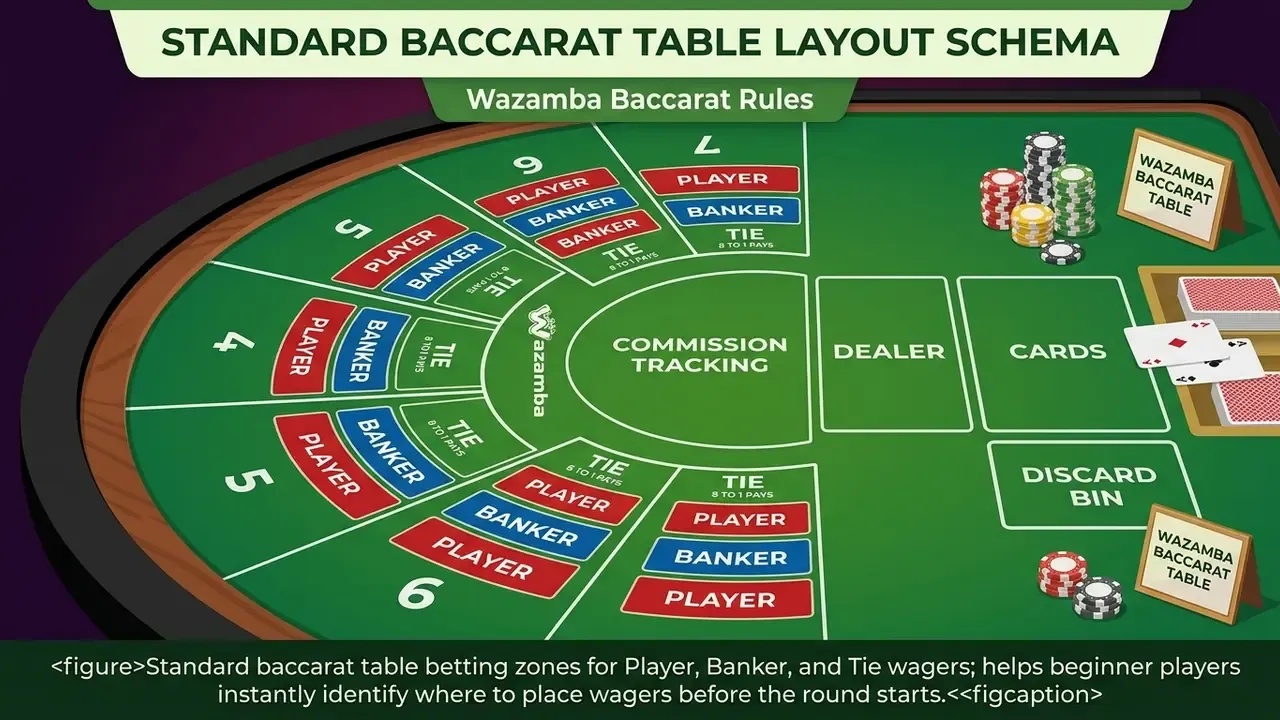
A standard baccarat table layout presents clear, dedicated betting areas designed to streamline wagering before the dealer starts the deal. The layout features three main betting zones for each participant seat: Player, Banker, and Tie.

Text equivalent of the diagram for

Text equivalent of the diagram (for screen readers and no-image loading): the dealer stands on the straight side of the table facing the betting arc. Across the curved edge, each seat carries three marked boxes ordered left to right as Player – Tie – Banker. The commission box sits next to the Banker side, where the 5% deduction on winning Banker bets is recorded before settlement.

In live dealer studios and online RNG games, the table also includes an electronic commission box. This zone tracks the standard 5% deduction applied to winning Banker bets, which keeps settlement transparent across every round.

Baccarat Rules: Cards, Scoring, and Round Progression

Mastering baccarat rules requires understanding how point values are assigned to individual cards and how hands are scored on a single-digit scale. The scoring system eliminates tens and double-digit totals through a modulo-10 calculation.

Card scoring follows three basic steps:

  1. Aces are worth 1 point.
  2. Cards 2 through 9 retain their face value.
  3. 10s, Jacks, Queens, and Kings are worth 0 points.

How Points Are Calculated per Card

To calculate a hand total, add the values of all dealt cards and drop the tens digit, keeping only the final right-hand digit. A hand of 7 and 8 totals 15, which becomes an effective score of 5.

A hand with a King and a 9 equals 9 points, a natural 9. Because tens count as zero, drawing a face card never raises or lowers your point total. This modulo-10 system guarantees that no hand total can ever exceed 9 points.

Three quick scoring examples:

Cards dealtRaw sumBaccarat total
7 + 8155
King + 999 (natural)
10 + 10 + 4244

Note that, unlike blackjack, there is no bust in standard baccarat. The tens digit is simply discarded, so a third card can lower your effective total rather than eliminate your hand. Slightly counterintuitive at first, but you get used to it within a few rounds.

Naturals and Third-Card Rules for the Player

A natural occurs when either hand receives an initial two-card total of 8 or 9 points. When a natural is dealt, no additional cards are drawn for either side, and the highest natural score wins the round.

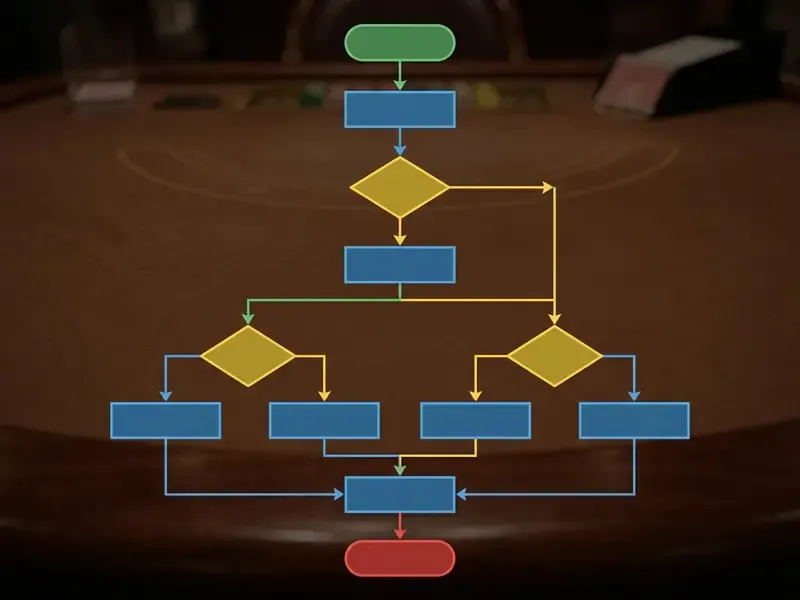
Text equivalent of the flowchart 1

Text equivalent of the flowchart: (1) bets are accepted on Player, Banker, Tie, and any side bets; (2) two cards are dealt to each hand; (3) the dealer checks for a natural 8 or 9, and if one is present the round ends; (4) if no natural appears, the Player hand draws on 0–5 and stands on 6–7; (5) the Banker hand then acts according to its own total and the value of the Player's third card; (6) totals are compared, the winning side is paid, ties are pushed, and the commission is deducted from winning Banker bets.

If neither hand holds a natural, the Player hand acts first based on a fixed rule:

Wazamba heading-banner
  • 0 to 5 points:The Player hand must draw a third card.
  • 6 or 7 points:The Player hand must stand.
  • 8 or 9 points:Natural stand; no cards are drawn.
When the Banker Receives a Third

When the Banker Receives a Third Card

The Banker hand follows a more conditional third-card rule set that depends both on its own initial two-card score and on the exact value of the third card drawn by the Player.

The dealer automatically executes the Banker's turn based on these parameters:

  • Banker total 0–2:Always draws a third card.
  • Banker total 3:Draws unless the Player's third card was an 8.
  • Banker total 4:Draws if the Player's third card was 2 through 7.
  • Banker total 5:Draws if the Player's third card was 4 through 7.
  • Banker total 6:Draws only if the Player's third card was a 6 or 7.
  • Banker total 7:Always stands.

Presented as a complete decision table:

Banker two-card totalBanker actionDepends on Player's third card
0DrawNo
1DrawNo
2DrawNo
3Draw unless Player's third card = 8Yes
4Draw if Player's third card = 2–7Yes
5Draw if Player's third card = 4–7Yes
6Draw if Player's third card = 6–7Yes
7StandNo
8–9Natural, round endsNo

Because the Banker acts second, it holds a subtle positional advantage. Empirical hand-by-hand analysis of eight-deck shoes confirms that edge in the raw outcome distribution:

«In an eight-deck game, the Banker wins 45.86% of rounds, the Player wins 44.62%, and 9.52% of outcomes are a Tie.» — Abe et al., empirical analysis of baccarat data, LiveCasinoData / WifiTalents 2026 Statistical Summary. https://livecasinodata.com

Strip ties out of the calculation and the Banker wins roughly 51% of decided hands. That is precisely why the house applies a commission to that side of the table. Nothing generous about it, just balance.

Bets in Baccarat: Player, Banker, Tie, and Commission

Every baccarat game offers three core wagering options, each carrying distinct payout schedules, mathematical probabilities, and house edges.

Bets on Player and Banker

A bet on the Player hand pays even money (1:1). A $100 wager returns $100 in profit plus your original stake if the Player hand beats the Banker. The house edge on the Player bet is 1.24%, which corresponds to a Return to Player (RTP) of 98.76%.

A bet on the Banker hand also pays 1:1, but carries a standard 5% commission on winning returns. A $100 winning bet on Banker yields a net profit of $95. Even with that deduction, the Banker bet keeps a lower house edge of 1.06% (RTP of 98.94%), making it the most mathematically favourable core wager on the table.

«House edge is 1.06% for Banker and 1.24% for Player; the Tie bet paying 8:1 hands the casino 14.36%.» — WifiTalents, 2026 Baccarat Statistics & Data Summary. https://wifitalents.com/statistic/baccarat/

Banker commission worked example (net payout calculator logic):

Stake (CAD)Gross win at 1:15% commissionNet profit
$10$10.00$0.50$9.50
$50$50.00$2.50$47.50
$100$100.00$5.00$95.00
$500$500.00$25.00$475.00

Use the same arithmetic to compare a standard table against a No Commission table. With commission you always lose exactly 5% of each Banker win. In No Commission play you keep 100% of most Banker wins, but you surrender half the payout whenever the Banker wins with a total of exactly 6.

Tie and Side Bets. The Tie

Tie and Side Bets

The Tie wager pays 8:1, or 9:1 at select tables, when both hands end with identical point totals. An 8:1 payout looks tempting, yet the true probability of a Tie is only 9.52%. That gap creates a steep 14.36% house edge (RTP of 85.64%). On a 9:1 table the same wager improves to roughly 4.84% house edge, but it still remains the worst value on the layout compared with Banker.

Many online tables also feature side bets such as Player Pair, Banker Pair, or Perfect Pair, paying up to 11:1 or 25:1 if the initial cards form matching ranks. Operational floor data quantifies exactly how much those wagers cost a player over time:

«When Tie wagers make up 4.6% of total handle, the effective house advantage rises from 1.15% to 1.73%, roughly 50% above the theoretical figure.» — Tangam Systems, Applied Baccarat Revenue Analysis (case study). https://tangamsystems.com

In plain terms: mixing even a small share of Tie or pair bets into an otherwise disciplined Banker session inflates your expected loss rate by half again, without changing the entertainment value of the round.

Odds and RTP of Different Bets

Understanding theoretical RTP helps set realistic expectations for your session. The core metrics across standard eight-deck baccarat are summarized below:

Bet TypeNet PayoutWin OddsHouse EdgeTheoretical RTPCommission
Banker0.95:145.86%1.06%98.94%5% on wins
Player1:144.62%1.24%98.76%None
Tie (8:1)8:19.52%14.36%85.64%None
Tie (9:1)9:19.52%4.84%95.16%None
Player/Banker Pair11:17.47%10.36%89.64%None

Fact Check & Probability Verification: Theoretical RTP reflects long-term mathematical averages over hundreds of thousands of hands, not a guarantee for a single short session. Independent laboratory testing shows real-world card game returns landing close to the theoretical ceiling across large samples:

«An audit of February 2024 game logs recorded an actual card-game RTP of 98.36%, near the maximum theoretical value.» — iTech Labs, Audit Report — Entain Plc Casino Game Logs, February 2024. https://itechlabs.com

Short-term variance still rules every session: across 100 hands, a 1.06% edge is statistically invisible beneath normal swings. Also check the commission rule at your specific table, because Super 6 and No Commission builds settle Banker wins differently.

How to Choose a Baccarat Casino and Access Offers

Selecting a safe, licensed platform ensures fair card dealing, protected account balances, and reliable payout processing. Settle this step before you decide between demo, RNG, and live dealer play. The licence and the payment rail determine whether your winnings can actually leave the account.

Licensing in Canada Ontario vs. the

Licensing in Canada: Ontario vs. the Rest of the Country

Canada regulates online gambling province by province, and the practical difference matters:

  • Ontario: the only fully open, provincially regulated private market. Operators must be registered with the Alcohol and Gaming Commission of Ontario (AGCO) and hold an operating agreement with iGaming Ontario (iGO). Registered sites appear in the public iGO/AGCO operator registry. Check the register before depositing, and confirm the site is serving you the Ontario-facing version (.on domains or an Ontario landing page are common signals).
  • Quebec, British Columbia, Alberta, Manitoba, Saskatchewan, Atlantic provinces: provincial Crown platforms (Loto-Québec, BCLC PlayNow, Play Alberta, and similar) are the domestically regulated option. Alongside them, many Canadians play at offshore-licensed sites.
  • Offshore licences commonly seen by Canadian players: Kahnawake Gaming Commission (KGC), issued from within Canada by the Mohawk Council of Kahnawake; Malta Gaming Authority (MGA), a strong EU standard with segregated player funds and dispute channels; Curaçao / Anjouan / Panama, with lighter oversight and weaker dispute mechanisms.

Practical rule of thumb: if you live in Ontario, prefer an iGO-registered operator, because you gain a provincial complaints pathway. Outside Ontario, prioritise MGA or KGC licences with published dispute procedures, and treat Curaçao-tier licences as higher risk on payout disputes.

What to Check at an Online

What to Check at an Online Casino Before Registering

Before depositing CAD at an online casino, run through these four essential criteria:

  1. Licensing & Regulation: Ensure the platform holds a valid licence from a recognized authority, such as iGaming Ontario for Ontario residents or established offshore regulators like the MGA or KGC for other provinces, and verify the licence number in the regulator's public register.
  2. Payment Processing & Speed: Verify support for Canadian payment methods like Interac e-Transfer, credit cards, or direct e-wallets, with fast withdrawal timelines (24–48 hours) and no hidden CAD conversion fee.
  3. Audit Certification: Confirm that the site's RNG and table games are regularly audited by independent labs like eCOGRA or iTech Labs.

    «A February 2024 audit confirmed actual card-game RTP of 98.36% for the operator's logs, above regulators' minimum requirements.» — iTech Labs, Audit Report — Entain Plc Casino Game Logs, February 2024. https://itechlabs.com

  4. Table Variety & Limits: Check for a healthy range of Punto Banco, No Commission, and live dealer baccarat tables, with limits matching your budget and a mobile layout that does not hide the bet confirmation button.

When evaluating operator standards and payout reliability across Canadian-facing sites, specialized iGaming site analyses provide valuable context on platform security and payment framework compliance.

CAD Deposits and Withdrawals: Interac and Alternatives

MethodTypical deposit speedTypical withdrawal speedCAD nativeNotes for Canadian players
Interac e-TransferInstant – 15 minSame day – 24 hYesFastest mainstream CAD rail; bank-to-bank, no card decline issues
Interac Online / DebitInstantNot always supportedYesGreat for deposits, often requires an alternative payout method
e-wallets (MuchBetter, Skrill, ecoPayz)Instant1 – 24 hUsuallyFast, but some operators exclude e-wallet deposits from bonuses
Visa / Mastercard creditInstant (declines possible)2 – 5 business daysYesCanadian issuers frequently block gambling MCC codes
Bank wire / EFT1 – 3 business days3 – 7 business daysYesBest for large VIP withdrawals; may carry a flat fee
Crypto (BTC, ETH, USDT)10 – 60 min15 min – 2 hNo (conversion)Fastest overall, but exchange-rate and conversion spread apply

Always complete identity verification (KYC) before your first withdrawal request. Verification delays, not payment rails, cause the majority of "slow payout" complaints.

Offers and Bonuses for Baccarat Players

Casino welcome bonuses and deposit matches can supplement your bankroll, but table game players must read the fine print carefully.

Baccarat bets often contribute only 5% to 10% toward bonus wagering requirements, precisely because the game's RTP runs so high. If a $100 bonus carries a 30x wagering requirement and baccarat contributes 10%, you must place $30,000 in total baccarat wagers to clear it for withdrawal.

Turnover required at different contribution rates for the same $100 bonus at 30x:

Baccarat contributionRequired baccarat turnover
100% (rare)$3,000
20%$15,000
10%$30,000
5%$60,000
0% (excluded)Bonus cannot be cleared with baccarat
Three bonus traps that specifically hit

Three bonus traps that specifically hit baccarat players:

  • Opposing or hedge betting is prohibited. Covering both Player and Banker in the same round, or Banker plus a large Tie stake to guarantee turnover, is classified as low-risk or "no-risk" betting. Operators routinely void bonus balances and confiscate winnings for that pattern. It is the single most common reason table-game bonuses get cancelled.
  • Max cashout caps. Many bonuses limit withdrawable winnings to a multiple of the bonus, for example 5x or 10x. A $100 bonus with a 5x cap pays out no more than $500 regardless of how much you accumulate.
  • Max bet per round while wagering. Typical ceilings are $5–$10 CAD per hand. A single larger bet placed with an active bonus can void the entire promotion, even accidentally.

Compliance & Responsible Gambling Disclaimer: Real money gambling is strictly restricted to individuals aged 19+ (18+ in AB, MB, QC). Gambling is a form of entertainment, not a source of income or a solution for financial hardship. Always set strict deposit and loss limits before playing. If you or someone you know is experiencing gambling-related harm, access free support resources across Canada via ConnexOntario or the Centre for Addiction and Mental Health (CAMH).

Additional Disclaimer: This information is general in nature and does not replace professional advice. Bonus terms, wagering requirements, and withdrawal rules are set individually by each operator and may change at any time. Always confirm the current terms on the casino's own website before depositing.

Types of Baccarat Online: From Punto Banco to No Commission

When you play baccarat online, you will meet several rule variations built for different game speeds and betting styles.

Punto Banco and Mini Baccarat for Beginners

Punto Banco is the standard baccarat variant across North America. The software or live dealer handles every card action according to strict rule tables, leaving no room for manual drawing mistakes.

Mini Baccarat uses identical rules and payouts as Punto Banco but runs on a streamlined table layout with lower minimum stakes, often starting at $1 CAD per hand. This fast-paced format suits players learning the rhythm of the game.

Chemin de Fer and Baccarat Banque

Chemin de Fer and Baccarat Banque

Chemin de Fer and Baccarat Banque are traditional European variants where players take turns acting as the banker and can make tactical decisions on third-card draws.

The distinction between the two lies in how the bank rotates. In Chemin de Fer ("railroad") the bank passes actively from player to player, and participants compete against whoever currently holds it. In Baccarat Banque, also called baccarat à deux tableaux, one designated banker holds the bank for a longer session against two player hands.

Because these formats require active player choices and peer-to-peer bank rolls, they are rarely found at online casinos, where automated Punto Banco rules dominate the market.

No Commission and Special Baccarat Games

No Commission and Special Baccarat Games

No Commission Baccarat removes the 5% deduction on winning Banker bets, paying 1:1 on most Banker wins. To offset that, if the Banker wins with a point total of exactly 6, the payout drops to 0.5:1 (half-pay). The rule shift raises the Banker house edge slightly to 1.46%.

Tables running this rule set, sometimes branded Super 6 or Punto 2000, frequently add an optional side bet on the Banker winning with a total of 6, paying around 12:1 on a two-card six and 20:1 on a three-card six.

Special online titles like Lightning Baccarat introduce random lightning multipliers (2x to 8x) applied to selected cards each round. Multipliers can boost payouts up to 512x on main bets, yet a 20% lightning fee is added to every wager, which keeps the base game RTP at approximately 98.76%.

«Lightning Baccarat's Banker bet RTP measures 98.76% once the 20% lightning fee is factored in.» — LiveCasinoData, RTP Transparency Monitor & Variant Comparison Table. https://livecasinodata.com

Top Baccarat Software Providers

Top Baccarat Software Providers

  • Evolution Gaming:the undisputed leader in live dealer baccarat, with high-payout titles such as Golden Wealth Baccarat, Lightning Baccarat, Peek Baccarat, and Dragon Tiger, plus randomized multiplier mechanics.
  • Pragmatic Play Live:offers fast-paced Speed Baccarat variants with 12-second betting windows and full roadmap tooling (Big Road, Bead Plate, Cockroach Pig).
  • Microgaming / Games Global:excellent for classic RNG Punto Banco, with an intuitive interface, flexible side-bet toggles, and low minimum stakes from around $0.50 CAD. Its first baccarat release dates back to 1999, making it one of the longest-running engines online.
  • NetEnt:launched Baccarat Pro in 2011 and has since added multiple RNG and live variants with clean, low-latency interfaces.
  • Play'n GO:known for optimized mobile titles like Mini-Baccarat, delivering ultra-smooth HTML5 performance across iOS and Android.
  • IGT:supplies electronic baccarat terminals to land-based venues and a simple, dependable online build for RNG play.
  • Betsoft and Novomatic:solid standard-ruleset RNG baccarat with polished presentation; Novomatic's 2017 release has been iterated repeatedly since launch.

Baccarat Demo, Free Games, and Live Dealer: Which Mode to Choose

Online casinos offer distinct environment options depending on whether you want risk-free practice or real-time table interaction.

Baccarat Demo and Free Games Without

Baccarat Demo and Free Games Without Real Money

A baccarat demo mode lets you play with virtual credits. It runs the exact same Random Number Generator (RNG) engine and drawing rules as real-money titles. The certified game build is identical, and the only difference is that the balance carries no cash value. Demo play cannot be "tightened" independently, because the RNG certificate covers a single tested game module.

Testing a free demo lets you practice hand scoring, watch third-card draws unfold, and try staking approaches without risking your bankroll. Demo credits, however, cannot be converted into real CAD withdrawals.

How to launch a baccarat demo without registering:

  1. Open the casino's or game aggregator's table-games lobby and filter by Baccarat.
  2. Hover or tap a title and select Demo / Play for Fun instead of Play Real.
  3. If a login wall appears, try the provider's own showcase page or a free-games portal. Most Punto Banco, Mini Baccarat, and No Commission RNG builds are available without an account.
  4. Note the starting virtual balance, often $1,000–$25,000 in fun credits, and scale your practice unit down to a realistic ratio, so the session mirrors your real bankroll.
  5. Play at least 50 hands using a single flat unit before switching to real money. Long enough to internalise third-card draws without memorising tables.

Live dealer tables are the exception: they are never available in demo mode, because each round consumes a real physical deal in the studio.

Baccarat Live Dealer and Live Casino

A baccarat live dealer table streams a real human croupier managing physical cards from a dedicated casino studio. You place digital bets on your screen, and they sync in real time with the dealer's physical table.

Online Baccarat Mode Comparison

Mode FeatureBaccarat DemoRNG Online BaccaratBaccarat Live Dealer
Real Money StakesNo (virtual credits)Yes (CAD)Yes (CAD)
Dealer TypeSoftware RNGSoftware RNGHuman croupier (video stream)
Game SpeedInstant / user-pacedFast (automated)Moderate (12–15 sec bet window)
Strategy TestingIdeal (zero cash risk)Possible, at real costPossible, at real cost
Primary PurposeRule practice & testingSolo real money playAuthentic baccarat live casino feel

Reading the table as a decision: use demo to learn scoring and confirm you understand the third-card sequence, use RNG tables when you want speed and micro-stakes, and pick live dealer play when transparency and pacing matter more than volume. Live tables let you watch physical cards drawn from a physical shoe, with dealer-led pacing, roadmaps, and chat interaction. That authenticity is exactly why the format stays popular with Canadian players.

Betting Limits and Baccarat Tournaments. Online

Betting Limits and Baccarat Tournaments

Online baccarat caters to every bankroll through structured limit tiers:

  • Micro / low stakes:$0.20 CAD – $5 CAD per hand (RNG tables, Mini Baccarat).
  • Standard tables:$1 CAD – $500 CAD per hand (live dealer Punto Banco and No Commission).
  • Mid tables:$25 CAD – $2,500 CAD per hand (Speed Baccarat and multi-seat live rooms).
  • VIP / high-roller Salon Privé:$1,000 CAD – $10,000+ CAD per hand with dedicated private croupiers and on-request shoe changes.

Baccarat tournaments: many licensed platforms run daily, weekly, or monthly leaderboards for table games. Players receive an equal stack of starting chips and compete across a fixed number of hands, and the highest final chip count claims the cash prize pool. Because the field plays the same number of hands, tournaments reward controlled aggression late in the round count rather than long-run edge. Entry usually costs a small buy-in or is unlocked by regular play.

Baccarat Strategy: How to Manage Bets and Money

Because baccarat drawing rules are fully fixed, no betting pattern or card-counting technique can overcome the built-in house edge. Effective baccarat strategy relies entirely on smart bet selection and disciplined bankroll controls.

Choosing Bets Based on Odds and Commission

The mathematical evidence points to one core rule: the Banker bet is the superior long-term option. With a house edge of 1.06%, it delivers the highest mathematical return over time.

The Player bet, at 1.24%, is an acceptable alternative if you would rather not track commissions. But avoid the Tie wager and the high-margin side bets. Their double-digit house edges accelerate bankroll depletion.

«Empirical observation shows players classify Tie and pair wagers as reckless, given house edges of 14.36% and 10.36%.» — Abe et al., Empirical Analysis of Baccarat Data (observational study, Japanese casinos). https://eprints.qut.edu.au

Rather than trusting an unpublished internal test, model the difference yourself. A flat $10 Banker-only session across 100 hands wagers $1,000 in total handle, carrying an expected cost of roughly $10.60 at a 1.06% edge. Add a $2 Tie bet to each of those 100 hands and you add $200 of handle at a 14.36% edge, roughly $28.72 in expected cost. That nearly triples the theoretical loss of the session while contributing only a fifth of the turnover. Methodology and sample size for any private testing should always be published; unverified session anecdotes are not evidence.

Why Progressive Systems Martingale Fail in

Why Progressive Systems (Martingale) Fail in Baccarat

Many players try to apply progressive betting systems such as the Martingale, doubling the wager after every loss, to the Banker bet. Mathematically, the approach is dangerous rather than clever. Each hand is an independent event: doubling changes the size of your exposure, never the 1.06% edge.

Table limits enforce the failure point. On a $1–$500 CAD table starting at $5, the doubling chain reaches $640 by the eighth loss, beyond the ceiling, so you cannot complete the recovery sequence. A streak of 8–10 consecutive Banker losses is entirely ordinary across a few hundred hands, and it either exhausts the bankroll or hits the table cap, which makes prior losses unrecoverable.

The same logic applies to Paroli, Labouchère, Fibonacci, and D'Alembert variants. They redistribute when you win or lose, and they change variance, but they never change expected value. Some players prefer to follow Banker streaks on the roadmap, which is harmless as a pacing habit. It confers no statistical advantage, though.

Money Limits and Game Plan. A

Money Limits and Game Plan

A structured money management plan protects your funds from natural variance:

  • Set a session loss limit:decide on a maximum loss threshold, say $100 CAD, before sitting down, and stop the moment you hit it.
  • Set a win goal:lock in profit by leaving the table when you grow your starting session bankroll by 20% to 30%.
  • Use fixed unit staking:size individual bets at 1% to 2% of your total session bankroll to absorb short-term losing streaks.
  • Play shorter sessions:the more hands you play, the more reliably the house edge asserts itself. Break long sittings into capped blocks.

«Across more than 1.4 million analysed rounds, observed RTP deviated from theoretical values by under 0.3 percentage points for correctly implemented games.» — LiveCasinoData, Live Casino Fairness Index (LCFI), snapshot 2024–2026. https://livecasinodata.com

Worked bankroll examples:

Session bankrollUnit size (1–2%)Stop-lossWin goal (20–30%)
$100 CAD$1 – $2$100$120 – $130
$200 CAD$2 – $4$200$240 – $260
$500 CAD$5 – $10$500$600 – $650
$2,000 CAD$20 – $40$2,000$2,400 – $2,600
Four session-control rules before you deal

Four session-control rules before you deal a hand:

  1. Deposit only the session bankroll, and never top up mid-session after a loss.
  2. Fix one unit size in advance and do not change it based on results.
  3. Write down the stop-loss and win goal, then close the table the moment either triggers.
  4. Set a hard time cap, 45 minutes for example, independent of the money outcome.

Bottom line: baccarat offers some of the best odds in the casino when you keep the focus on core Banker wagers. Test rules risk-free in baccarat demo mode, choose licensed Canadian casino platforms, read bonus terms line by line, and hold strict limits on every session.

FAQ: Common Questions About Baccarat in Canada

Respuestas renderizadas en formato acorde al diseГ±o exportado: tarjetas oscuras, acento dorado y despliegue compacto.

1

Is online baccarat legal in Ontario?

Yes. Ontario operates a regulated private iGaming market: operators registered with the AGCO and holding an agreement with iGaming Ontario may legally offer real-money baccarat to Ontario residents aged 19+. Confirm the operator appears in the public iGO/AGCO registry before depositing.
2

What about players outside Ontario?

Other provinces offer their own Crown-run platforms (PlayNow, Loto-Québec, Play Alberta, and similar). Many Canadians outside Ontario also play at offshore-licensed sites, most commonly under Kahnawake, Malta, or Curaçao licences. Those sites are not provincially regulated, so licence quality and published dispute procedures matter more.
3

Are demo baccarat games rigged in the casino's favour?

No. The demo build runs the same certified RNG module as the real-money version, and the difference is purely the balance type. Certification from labs such as iTech Labs or eCOGRA covers the single tested game module rather than a separate "free" copy.
4

Can I bet on Player and Banker at the same time while clearing a bonus?

Technically the interface may allow it, but nearly every operator classifies opposing bets, hedge betting, and heavy Tie coverage as low-risk or no-risk play. Doing so with an active bonus typically voids the bonus and any winnings derived from it. Play one side per round.
5

Which bet has the lowest house edge?

Banker, at 1.06% (98.94% RTP), even after the 5% commission. Player is 1.24%; Tie at 8:1 is 14.36%.
6

Does No Commission Baccarat give better value?

Not quite. Removing the 5% commission but half-paying Banker wins on a total of 6 raises the Banker house edge from 1.06% to roughly 1.46%. It is faster and simpler to track, yet slightly worse mathematically.
7

How fast are CAD withdrawals?

Interac e-Transfer is generally the quickest mainstream option, often same-day to 24 hours after verification. Cards and bank transfers take 2–5 business days. Crypto rails clear fastest overall but add conversion spread.
8

Do baccarat bets count toward wagering requirements?

Usually only 5–10%, and some promotions exclude table games entirely. Always check the contribution table in the bonus terms before you deposit for a table-game bonus.
9

Can card counting or pattern tracking beat baccarat?

No. Drawing rules are fixed and each shoe outcome is effectively independent for betting purposes. Roadmaps (Big Road, Bead Plate, Cockroach Pig) are pacing and record-keeping tools, not predictive ones.
10

What is the minimum I can bet online?

RNG and Mini Baccarat tables start around $0.20–$1 CAD per hand; standard live tables typically start at $1–$5 CAD; VIP Salon Privé rooms begin at $1,000 CAD and run to $10,000+ per hand.
11

Is baccarat suitable for absolute beginners?

Yes, because it requires no in-hand decisions. Learn the modulo-10 scoring, place a flat Banker bet, and let the fixed rules handle the rest. Practise in demo mode first.
Pre-Deposit Checklist and Responsible Play

Pre-Deposit Checklist and Responsible Play

  • ☐ Licence verified in the regulator's public register (iGO/AGCO, KGC, or MGA).
  • ☐ Independent RNG/table-game audit certificate visible (eCOGRA, iTech Labs).
  • ☐ Interac e-Transfer or another CAD-native method available for both deposit and withdrawal.
  • ☐ Withdrawal timelines and any fees published in the banking terms.
  • ☐ Baccarat contribution rate, max bet, and max cashout read in full before claiming any bonus.
  • ☐ Deposit limit, loss limit, and session time limit configured in account tools.
  • ☐ KYC documents uploaded before the first withdrawal request.
  • ☐ Table limits match a 1–2% unit of your session bankroll.

Responsible gambling reminder: gambling must remain entertainment. If play stops being fun, or if you catch yourself chasing losses, use the operator's self-exclusion and cooling-off tools and contact free Canadian support services, either ConnexOntario (24/7 helpline) or the Centre for Addiction and Mental Health (CAMH). Age restrictions apply: 19+ in most provinces, 18+ in Alberta, Manitoba, and Quebec.

Compare on the facts, read the terms before you deposit, and play within limits. 19+.

Appendix A Source Attributions and Verification

Appendix A: Source Attributions and Verification Notes

For transparency, earlier versions of this guide carried the following formulations, now replaced above by verified, quantified sources:

  1. "Research on baccarat probability from The Wizard of Odds (2024) confirms that in an eight-deck shoe, the Banker hand wins 45.86% of rounds, the Player hand wins 44.62%, and 9.52% end in a Tie." — The probability figures remain accurate, but the attribution has been updated to Abe et al. via the LiveCasinoData / WifiTalents 2026 statistical summary.
  2. "Operational research published by Tangam Systems shows that placing frequent side bets significantly increases your effective rate of loss over time." — Replaced with the quantified Tangam Systems finding (4.6% Tie handle share; effective edge rising from 1.15% to 1.73%).
  3. "Audits conducted by iTech Labs (February 2024) confirm that real-world card game returns cluster tightly around theoretical expectations across large sample sizes." — Replaced with the specific audited figure of 98.36% actual card-game RTP.
  4. "In our practical testing of online table sessions, placing fixed $10 unit wagers exclusively on Banker over 100 hands resulted in steady session control and predictable outcome variance, whereas adding $2 Tie side bets significantly increased overall session losses." — Reformulated as a transparent expected-value calculation, since the original claim lacked published methodology and sample size.