
Last updated: 2026. Figures verified against provider paytables and operator reports at the time of publication.
Mines Game: Play Online Free, in Demo or for Real Money
Provider
Hacksaw Gaming
RTP
99.00%
Volatility
Variable
Min bet
0.01
Max win
10,000x stake
«Mines-style crash games put players in direct control of when to walk away, and that feeling of control is exactly where the trap sits. Our review process tests sign-up, CAD deposits via Interac, and an actual cash-out before any brand gets a score, because the fine print matters far more than a headline bonus.» — Reid Calloway, Independent iGaming Analyst (editorial persona)
Mines in 60 Seconds
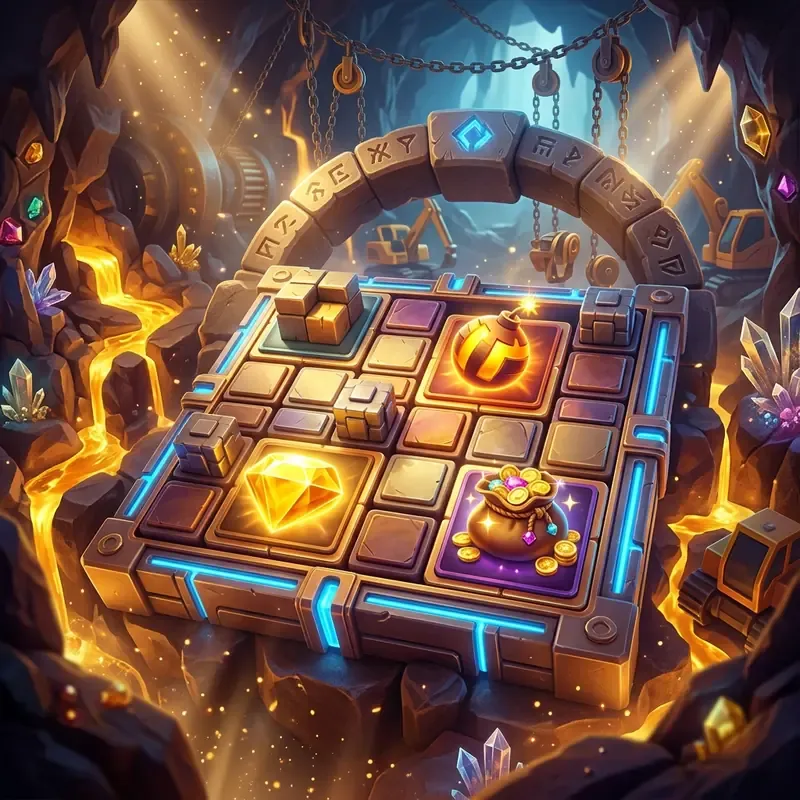
Mines is a bet-and-reveal instant-win game. You open tiles on a grid, usually 5×5, grow a payout multiplier with every safe pick, and lose the stake the moment you touch a hidden mine. Simple premise. Sharper edges than it looks.
Demo mode runs on the same RNG engine but pays only virtual credits. Real-money play in Canada needs a licensed operator, CAD banking (most often Interac e-Transfer), and a careful read of the bonus wagering terms, because crash and instant-win titles frequently contribute just 5-10% toward rollover. Published RTP is provider-specific: roughly 96% (Nyx), 97% (Spribe), 98% (Hacksaw Gaming) and up to 99% (Stake Originals). And no staking system, whether Martingale, Anti-Martingale, Paroli or the "10 Bets" cycle, converts a negative expected value into a positive one.
What Is Mines Game and What Makes It Different
Mines is an instant-win, bet-and-reveal crash game. Players select hidden tiles on a grid to uncover safe multipliers, avoid concealed mines, then cash out. Unlike a traditional slot governed by fixed reel spins, the Mines game hands pacing to the user, allowing a decision after every single tile reveal.
The casino format borrows its look from classic Microsoft Minesweeper (1989), but the underlying logic is a different animal. Traditional minesweeper is a deterministic puzzle: numbers inside opened cells give logical clues about adjacent hazards. Casino Mines is pure gambling driven by a provably fair random number generator. No numeric clues at all. Mine positions are fixed cryptographically before or during the round.
Major studio builds, including those from Spribe, BGaming and Hacksaw Gaming, adapt the grid-and-mine concept into a fast-session crash mechanic. Each safe pick lifts a dynamic payout multiplier; one mine forfeits the wager for that round. That is the whole game loop, and it repeats in seconds.
+--------------------------------------------------------------------+
|                    CLASSIC vs CASINO MINES                         |
+------------------------------------+-------------------------------+
| Classic Minesweeper (1989)         | Casino Mines Game (e.g. Spribe)|
+------------------------------------+-------------------------------+
| • Deterministic logic puzzle       | • RNG / Provably Fair gambling|
| • Numeric clues reveal neighbors   | • Zero cell clues (pure risk) |
| • Goal: Clear entire board         | • Goal: Build multiplier & cashout|
| • No financial stake involved      | • Real money stake / cash out |
+------------------------------------+-------------------------------+
Why does this distinction matter for a Canadian player? Because skill transfer is zero. Hours logged on desktop minesweeper build no edge here. What carries over is patience, and patience is a bankroll tool, not a probability tool.
Looking for a vetted platform? Our editorial hub of iGaming analysis resources lists licensed operators with verified RTP disclosures, CAD deposits via Interac, and transparent bonus terms, so you can compare offers before placing a first $1.00 CAD stake.
Provider Comparison: Spribe vs Hacksaw vs Stake Originals vs Nyx
The single most common mistake is treating "Mines" as one game. It is a format. Each studio publishes its own configuration, mine range, grid options and return figure. The table below consolidates the parameters published by the four implementations Canadian players meet most often.
| Provider / Version | Published RTP | Mine Range | Grid Options | Bet Range (typical) | Max Win / Multiplier | Distinguishing Feature |
|---|---|---|---|---|---|---|
| Spribe Mines | 97.00% | 1 – 20 | 5×5 | Operator-set (often $0.10–$100 CAD) | Up to 10,000x (config-dependent) | Classic interface, auto-play, widest operator distribution |
| Hacksaw Gaming Mines | 98.00% (tested over 10 billion simulations) | 1, 3, 5, 7 presets + custom | 3×3, 5×5, 7×7, 9×9 | $0.20 – $1,000 | x10,000 | Selectable grid size; HTML5 across Windows, macOS, Android, iOS |
| Stake Originals Mines | ~99.00% (1% house edge) | 1 – 24 | 5×5 | Operator-set | Dynamic, escalates with mine count | Lowest published house edge; provably fair seed verification |
| Nyx Mines (BetMGM) | 96.00% (varies by jurisdiction) | 1 – 20 | 5×5 | $0.20 – $1,000 | 10,000x | Regulated US/Canada distribution, conservative configuration |
| BGaming Mines | Configuration-dependent, verify in paytable | Operator-set | 5×5 | Operator-set | Operator-set | Demo and real-money builds published in parallel |
Two practical takeaways follow. First, a two-point RTP spread (96% versus 98%) is a 100% difference in house edge, 4.00% against 2.00%. At roughly 78 rounds a day, the average engagement recorded in operator data, that gap compounds into real money. Second, mine range matters: a 24-mine ceiling on Stake Originals enables far more extreme volatility profiles than a 20-mine ceiling elsewhere.
One more note worth flagging. RTP is a long-run figure across millions of rounds, not a promise for your session. Nyx states plainly that its number "may differ from one jurisdiction to another", which is a polite way of saying check the info panel in your province.

How Stake, Multiplier and Cash Out Work
You set a base stake before the round. Each consecutive safe tile lifts a dynamic payout multiplier applied to that stake.
The financial structure rests on three linked metrics: the base bet, the dynamic multiplier ($x$), and the cash-out mechanism. The instant a safe tile opens, the system recalculates ($Payout = Stake \times Multiplier$). Then comes the choice: press cash out and lock the accumulated payout, or risk the whole accrued win on another tile.
The empirical basis here is specific rather than vague. An evaluation of 20,038 crash-game rounds published by Dubach (2026) in the Gambling Fairness Paradox study found an outcome distribution exponent of $\alpha \approx 1.98$, statistically matching theoretical fairness, while documenting an expected loss velocity above 500% of wagered amounts per hour during high-frequency play at 179 rounds per hour.
«Even in a cryptographically verifiable fair crash game, expected losses exceed 500% of wagered amounts per hour at 179 rounds per hour.» — Dubach, Gambling Fairness Paradox (2026)
So verifiable fairness and long-run profitability are separate questions entirely. Multiplier curves generate headline numbers; long-term returns stay bounded by a fixed house edge. Which is why locking a result through cash out, before a mine appears, is the only mechanism by which a player secures anything in an individual round.
Quick probability calculator, no software needed. To estimate survival across consecutive clicks on a 5×5 grid with $m$ mines, multiply the shrinking fractions:
$$P_2 = \frac{25 - m}{25} \times \frac{24 - m}{24}$$
Example with 3 mines: $22/25 \times 21/24 = 88.0% \times 87.5% = 77.0%$. Extend to a third click by multiplying by $\frac{23-m}{23}$ ($20/23 = 87.0%$), which gives $67.0%$. Roughly one round in three fails before the third gem, even on what most players call a "safe" setting.

How to Play Mines Online: Quick Instructions
1
Select a verified operator. Log in to a licensed online casino offering certified Mines titles from Spribe, BGaming, Hacksaw Gaming or Stake Originals.
2
Set your base stake. Enter the bet amount, say $1.00 CAD to $50.00 CAD, using the stake panel.
3
Configure the mine count. Choose how many hidden mines go on the grid, typically 1 to 20, up to 24 on Stake Originals.
4
Check the grid size if it is adjustable. On Hacksaw-style builds, confirm whether you are on 3×3, 5×5, 7×7 or 9×9 before the first click. The payout bar above the grid shows current and upcoming multipliers for that configuration.
5
Start the round and reveal tiles. Click start, then tap face-down tiles one at a time.
6
Evaluate or cash out. After each safe reveal, read the current multiplier and either tap "Cash Out" or select another tile.
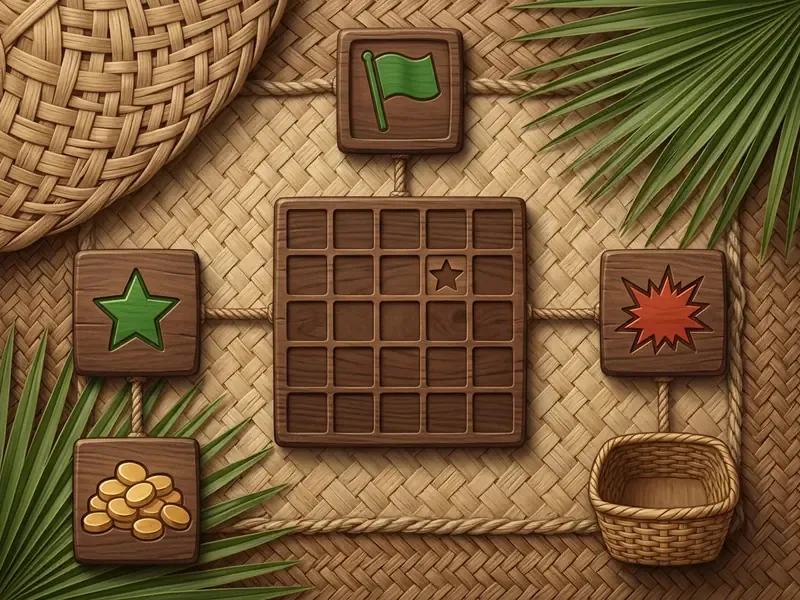

[Start Session] ➔ [Set Stake (CAD)] ➔ [Select Mine Count (1-20)]
                         │
                         ▼
               [Click Hidden Tile]
                         │
        ┌────────────────┴────────────────┐
        ▼                                 ▼
  [Safe Symbol]                     [Hidden Mine]
        │                                 │
        ▼                                 ▼
[Multiplier Increases]              [Round Ends]
        │                           [Stake Lost]
   ┌────┴────┐                            │
   ▼         ▼                            ▼
[Cash Out] [Next Tile]              [Reset Session]
   │
   ▼
[Payout Locked]
Description: flowchart outlining the step-by-step decision tree for an online Mines round. Semantics: figure block containing structured text navigation; key decision nodes indexed for screen readers and search crawlers.
Choosing the Mine Count and Risk Level
The number of mines you select directly rewrites volatility, safe-tile probability and multiplier growth rate.
Every mine you add changes the risk-reward ratio of every click. A low count, 1 to 3 mines on a 25-tile grid, gives a high baseline chance of landing safe tiles: 92% on click one with 2 mines. But because survival is probable, the multiplier creeps up in small steps. Push to 10 or 15 mines and the first-click safe probability collapses to around 60% or lower, while the paytable compensates with steep multiplier jumps on even the first or second successful reveal.
There is no hidden optimum. Both ends of the range are calibrated to the same house edge; only the shape of your session changes.
Probability and Multiplier Reference Table
The table below shows cumulative survival probability by click depth on a standard 5×5 grid, next to the theoretical fair multiplier implied by a 97.00% RTP configuration ($\text{Multiplier} = \text{RTP} \div P_{\text{cumulative}}$). Use it to sanity-check any paytable you meet in a live game.
| Safe Clicks | 3 Mines — Survival | 3 Mines — ~Multiplier | 5 Mines — Survival | 5 Mines — ~Multiplier | 10 Mines — Survival | 10 Mines — ~Multiplier |
|---|---|---|---|---|---|---|
| 1 | 88.0% | 1.10x | 80.0% | 1.21x | 60.0% | 1.62x |
| 2 | 77.0% | 1.26x | 63.3% | 1.53x | 35.0% | 2.77x |
| 3 | 67.0% | 1.45x | 49.6% | 1.96x | 19.8% | 4.90x |
| 4 | 57.8% | 1.68x | 38.3% | 2.53x | 10.8% | 8.99x |
| 5 | 49.6% | 1.96x | 29.2% | 3.32x | 5.7% | 17.2x |
Figures are theoretical illustrations derived from combinatorics at a 97% RTP setting. Actual published multipliers vary by provider (98% at Hacksaw, ~99% at Stake Originals, 96% at Nyx) and by grid size. Always confirm against the in-game paytable.
The key insight for bankroll planning: at 10 mines, five consecutive safe clicks land in roughly 1 round out of 18. Chasing that 17x payout means budgeting for the 17 losing rounds around it.
When to Lock In a Result in Mines
Lock in via cash-out when the current multiplier hits a bankroll target you set beforehand, or when the probability of striking a mine on the next pick outweighs the incremental reward.
This is the central tactical point in Mines. Controlled experiments by Bennett et al. (2024) on cash-out mechanics found that simply offering a mid-round cash-out option pushed participants to raise their initial bet sizes by 23.6% to 34.8%, thanks to a perceived safety net.
«The availability of cash-out increased participants' stakes by 34.8% in experiment one and 23.6% in experiment two (Cohen's d = 0.75 and 0.46).» — Bennett et al., controlled experiments, n = 240 (2024)

Read that carefully. The button that protects you also nudges you to stake more. Meanwhile, delaying cash-out for extreme multipliers exposes accumulated gains to negative variance, and a single mine erases every safe pick before it. Securing payouts at modest, consistent multipliers is what shields a session bankroll from sudden drawdowns.
A practical decision rule: compute the marginal expected value of the next click as $EV_{\text{next}} = P_{\text{safe}} \times \text{Payout}{n+1} - (1 - P{\text{safe}}) \times \text{Payout}{n}$. Because $P{\text{safe}}$ declines with every reveal while paytables are built around a fixed edge, $EV_{\text{next}}$ is never positive over the long run. Meaning the "correct" cash-out point comes from your risk tolerance and session budget, not from some hidden mathematical sweet spot.
Mines Demo and Free Mines: Playing Without Stakes
Mines demo and free-play modes let you test grid mechanics, check UI responsiveness and practise stake management on virtual credits, with no deposit and no capital at risk.
Demo mode runs the exact same random number generator and the same mathematical logic as the real-money build. Virtual credits land in the session balance, so you can switch mine configurations and rehearse cash-out timing without cost. Free Mines play works as an educational sandbox for watching how fast multipliers scale under different settings. Payouts there are virtual credits only, though. They cannot be withdrawn to a bank account or e-wallet.
One caveat deserves emphasis: "free" and "instant" formats are not psychologically neutral.
«Around 40% of operators offer instant prizes, which may be more addictive due to immediate reward.» — UK Government, Market Study on Online Prize Draws (2024)
That immediacy is precisely what makes Mines demo mode useful for learning mechanics, and precisely what makes it a poor gauge of your emotional response once real CAD is on the line. Treat demo results as a UI and pacing test. Never as a performance forecast.
| Parameter | Mines Demo | Free Mines (Bonus Balance) | Mines Real Money |
|---|---|---|---|
| Deposit Requirement | None required | None (no deposit bonus) or min deposit | Real-money deposit required |
| Balance Type | Virtual credits (resettable) | Bonus funds / free bets | Real CAD cash balance |
| Payout Eligibility | ❌ No real payouts | ⚠️ Subject to wagering rules | ✅ Real-money CAD withdrawals |
| Primary Purpose | Practice & UI testing | Promotional trial | Real-money gambling |
| Financial Risk Level | Zero financial risk | Zero direct capital risk | Full risk of stake loss |
| RNG Engine | Identical to real money | Identical to real money | Identical to demo |
In short: demo teaches the interface, free Mines tests bonus terms, real money carries the actual risk. Three different jobs, often confused for one.
Not sure which format to start with? You can try Mines in demo mode on platforms from our review shortlist at Casino, with no deposit and the same RNG mechanics used in real-money rounds.
Mines for Real Money: How to Evaluate a Casino Offer
⚖️ Disclaimer: this information is general in nature and does not replace professional advice. Real-money gambling is available only to persons aged 19+ (18+ in AB, MB, QC). Confirm your chosen operator holds a valid, current licence before depositing.
Evaluating a real-money Mines offer comes down to four checks: the operator's provincial licence, CAD payment methods such as Interac, bonus wagering contributions, and published RTP figures.
Moving from demo to real stakes makes platform choice the deciding factor in whether you actually get paid. Canadian players should prioritise sites that operate transparently, display clear regulatory licensing, support local CAD payment rails, and apply fair terms to crash games rather than burying them in exclusions.
How We Score Mines Casinos for Canadian Players
Instead of publishing an unverifiable brand list, our editorial framework scores every candidate against six auditable criteria. Treat it as a scorecard you can run yourself in under ten minutes.
| Criterion | What to Verify | Pass Standard | Fail Signal |
|---|---|---|---|
| Licence | Footer licence number; cross-check on the regulator's register (AGCO / iGaming Ontario for ON; Kahnawà:ke; MGA for offshore) | Licence number resolves to an active record naming the same legal entity | No number, expired record, or entity mismatch |
| CAD & Interac | Cashier page before deposit | Interac e-Transfer / Interac Online listed for both deposit and withdrawal in CAD | CAD deposit but crypto-only withdrawal |
| Mines supplier | Game info panel inside the title | Named studio (Spribe / Hacksaw / BGaming / Stake Originals) plus published RTP | Unbranded clone, no RTP disclosure |
| Wagering contribution | Bonus T&Cs, "game weighting" clause | Instant-win/crash contribution stated numerically (5%, 10%, 100%) | Silence, or "at management discretion" |
| Max bet under bonus | Bonus T&Cs | Explicit cap (e.g. $5.00 CAD) you can live with | No cap stated, retroactive confiscation risk |
| Withdrawal timeline | Payments/T&Cs page | Stated processing window for Interac, commonly 0–24h after KYC | "Up to 14 business days", no KYC guidance |
Where an operator does not publish one of these parameters, record it as no data and price it as a risk premium rather than a neutral blank.
Deposit, Bonus and Available Game Options
Casino deposit bonuses often carry strict game-weighting rules, and instant-win games like Mines usually contribute a smaller percentage toward wagering than standard video slots.
Many welcome packages match a first CAD deposit, for example 100% up to $500 CAD. The fine print then quietly limits how crash and instant-win titles satisfy the rollover. Slots typically count 100%; Mines may count 10%, 5% or nothing at all.
Editorial review case (situation, action, result):
- Situation:a Canadian player deposited $100 CAD, claimed a welcome bonus, built winnings on Spribe Mines, then had a withdrawal request rejected.
- Action:our editorial evaluation audited the bonus terms and found a clause setting instant-win contribution at 5% toward a 35x wagering requirement, plus a $5.00 CAD max bet cap during active bonus play.
- Result:identifying those restrictions showed that declining the bonus and playing Mines with raw CAD cash preserved 100% cash-out flexibility via Interac e-Transfer, with no wagering delay. Our broader iGaming analysis resources carry additional framework evaluations.
The withdrawal behaviour behind that case is itself well documented. Research into operator messaging found that prompting players at the right moment measurably changes cash-out discipline:
«38% of players who received a personalised winning-streak message withdrew funds the same day; message readers withdrew larger amounts.» — Auer & Griffiths, Journal of Gambling Studies, n = 4,049 (2024)
The translation for Mines is blunt. Hit your session profit target, withdraw it that day. Money left sitting in a casino wallet is statistically far likelier to be re-staked than money already in your bank account.
4 Checks Before You Deposit for Mines
- Licence check, about two minutes. Copy the licence number from the site footer and confirm it on the regulator's public register. In Ontario that means AGCO / iGaming Ontario.
- Interac round-trip check. Confirm Interac e-Transfer appears under both deposits and withdrawals in CAD, and note the stated processing window plus any minimum withdrawal amount.
- Bonus weighting check. Search the T&Cs for "instant win", "crash", "game weighting" and "excluded games". If Mines contributes 5% toward a 35x requirement, the effective rollover is 700x the bonus, which is usually reason enough to decline.
- Max-bet-under-bonus check. Note the cap, commonly $5.00 CAD. Exceeding it by even $0.50 CAD is the single most frequently documented cause of voided winnings.
Fail any one of the four? Play in demo mode or move to a different operator. Declining a bonus and playing with raw CAD keeps 100% of your balance withdrawable, which is worth more than most match offers on the market.
RTP, Payout and Bet Limits
There is no single "Mines RTP". Return to player is provider- and configuration-specific, and only some values are independently documented. Verified at the time of writing: Spribe at 97.00%, Hacksaw Gaming at 98.00% (validated across 10,000,000,000 simulations per the studio's published testing note), Stake Originals at approximately 99.00% (1% house edge), and Nyx / BetMGM at 96.00%, with the operator noting RTP "may differ from one jurisdiction to another". Where a casino does not publish the figure for the exact build you opened, treat it as no data and check the in-game info panel.
Data from the KTO Mines operator report (2024) gives an empirical window into real-world performance for Mines by Spribe:
- Official stated RTP:97.00%
- Observed monthly RTP range:96.00% (April minimum) to 97.91% (June peak)
- Most common stake:1 unit, reflecting low-stakes entry points
- Maximum recorded multiplier:2,771.58x (June 2024)
- Average engagement:roughly 78 rounds per active player per day
«Official Mines RTP is 97%; realised range ran from 96% (April) to 97.91% (June 2024), with a maximum multiplier of 2,771.58x.» — KTO Mines Operator Report (2024)
Multipliers above 2,000x are mathematically achievable, yes, and vanishingly rare in practice. Betting limits vary by operator: Hacksaw publishes $0.20 to $1,000 per round, Nyx publishes the identical $0.20–$1,000 band, while operator-side caps on Spribe builds commonly sit between $0.10 CAD and $100 CAD. Inspect the paytable menu to confirm your specific limits, and remember that bonus-active max bet caps override normal table limits.

Mines Mobile and "Download": Browser, PWA and APK Risks
Modern Mines games are built on HTML5 and run inside mobile browsers on iOS and Android. No dedicated app download needed.
You do not need an APK or any software package to play Mines on a phone. Licensed casinos serve HTML5 web clients that scale the 5x5 grid, buttons and displays to smartphone screens automatically. Hacksaw's Mines build, for instance, ships for Windows, macOS, Android and iOS from a single HTML5 client. One codebase, no installer.
⚠️ APK security warning. Downloading third-party "Mines.apk" files from unofficial sites carries a real risk of malware, credential theft and fake-balance scams. Licensed casinos do not distribute standalone executable Mines game files. The safe routes on mobile are: (1) the HTML5 web version in Safari, Chrome, Firefox or Edge; (2) your casino's official Progressive Web App or "Add to Home Screen" shortcut; (3) the operator's official listing in the Apple App Store or Google Play. If an app promises guaranteed Mines wins, predictions or a "hack", it is a scam by definition, because outcomes are RNG-generated server-side.
Minimum safety practices for mobile play:
- Official sources only. Install casino apps from the App Store, Google Play, or a direct link on the operator's verified domain.
- Keep the client updated. Updates carry security patches for known vulnerabilities in payment and session handling.
- Strong, unique passwords plus 2FA. Never reuse a password across casino and banking accounts; enable two-factor authentication wherever it is offered.
- Verify the operator before registering, not after. Check the licence register and independent reviews before your first deposit.
- Confirm the padlock and the domain spelling. Mines-themed phishing clones usually differ from the real casino domain by a single character.
[🖼️ ANNOTATED SCREENSHOT: Mobile Mines UI Layout] (alt text: "mines mobile game")
+---------------------------------------------------+
|  [≡ Menu]         Mines Mobile         [CAD $125] |
+---------------------------------------------------+
|                                                   |
|                [ CURRENT MULTIPLIER ]             |
|                       1.48x                       |
|                                                   |
|         +-----+  +-----+  +-----+  +-----+        |
|         |  ★  |  |  ★  |  |  ?  |  |  ?  |        |
|         +-----+  +-----+  +-----+  +-----+        |
|         |  ?  |  |  ★  |  |  ?  |  |  ?  |        |
|         +-----+  +-----+  +-----+  +-----+        |
|         |  ?  |  |  ?  |  |  ?  |  |  ?  |        |
|         +-----+  +-----+  +-----+  +-----+        |
|                                                   |
|  [ Stake: $2.00 CAD ]     [ Mines: 3 ▲▼ ]         |
|                                                   |
|             [   CASH OUT ($2.96 CAD)   ]          |
|                                                   |
+---------------------------------------------------+
Description: annotated layout of the mobile Mines interface on a smartphone screen. UI components:
- Header bar: navigation menu, title and live CAD account balance.
- Multiplier display: prominent real-time reading of the active round multiplier, here 1.48x.
- Central grid: touch-optimised 5x5 tile field showing revealed safe symbols and concealed tiles.
- Control panel: input fields for the CAD stake amount and the mine count, 1 to 20.
- Cash out button: full-width button displaying the exact current cash-out value in CAD.
Research by Hing et al. (2023) on smartphone gambling found that portable, private access combined with rapid electronic transactions increases the potential for impulsive play.
«Regression models across 1,378 sessions showed that betting anywhere, privacy, and promotion access were significantly associated with short-term gambling harm.» — Hing et al., Journal of Behavioral Addictions, n = 267 (2023)
When playing Mines on mobile, use the platform's built-in session timers and deposit limits. Switching off push notifications for promotional offers removes one documented trigger for unplanned sessions. Small change, measurable effect.
Mines Strategy: Systems, Risk and Stake Management
⚖️ Disclaimer: general information only. No betting strategy changes the negative mathematical expectation of the game. Real-money play carries a risk of financial loss.
Mines strategies are stake-management systems that structure volatility. None of them alters the negative expected value set by the house edge.
Because Mines runs on cryptographic RNGs, past round outcomes have zero influence on future tile distribution. Each click is an independent event. Systems change the distribution of wins and losses across a session; they do not bypass the built-in advantage of the casino. Provably fair verification confirms a round was not tampered with. It does not tilt the odds toward you.
+--------------------------------------------------------------------+
|                   MINES RISK PROFILE MATRIX                        |
+-------------------+-----------------------+------------------------+
| Metric            | Low-Risk Strategy     | High-Risk Strategy     |
+-------------------+-----------------------+------------------------+
| Mine Configuration| 1 – 3 Mines           | 10 – 15+ Mines         |
| Target Multiplier | 1.10x – 1.50x         | 10.00x – 100.00x+      |
| Win Frequency     | High (~80% - 90%)     | Low (~5% - 20%)        |
| Drawdown Severity | Gradual / Low         | Rapid / High           |
| Primary Hazard    | False security traps  | Rapid bankroll depletion|
+-------------------+-----------------------+------------------------+
Low-Risk and High-Risk Approaches in Mines
Low-risk play uses 1-3 mines with early cash-outs for frequent small payouts. High-risk play deploys 10+ mines chasing large multipliers and accepting frequent round losses.
- Low-risk approach. Configure 1 to 2 mines on the 25-tile grid. Opening 1 to 3 safe tiles is highly probable. Cash out routinely between 1.15x and 1.35x. Frequent small wins, yes, but one mine hit wipes the gains of several successful rounds. A structural variant popular on Stake-style builds is the 1:1 ratio: one mine, one tile per round, repeated continuously. Statistically the highest-frequency, lowest-payout configuration available.
- High-risk approach. Set 10 or more mines. Most rounds die on the first or second click. Survive 3 to 4 reveals, though, and multipliers reach 15x to 50x and beyond. High variance, and it demands a bankroll that can absorb long losing streaks without emotional damage.
Analyses of chasing behaviour by Zhang et al. (2024) across 1.9 million online casino sessions found that high-volatility formats shorten the interval between sessions after wins, which amplifies exposure to loss chasing.
«Across 1,909,681 sessions, roulette, a high-volatility format, was associated with shorter return times (b = −0.13, p < 0.001) compared with slots.» — Zhang et al., Journal of Behavioral Addictions, n = 15,544 (2024)
High-mine Mines configurations produce a similar psychological pull. The faster and more volatile the format, the shorter the gap before you open the tab again.

Martingale, Anti-Martingale and Paroli Strategy
Martingale doubles stakes after a loss to recover the deficit. Paroli doubles after wins. Neither changes long-term RTP, and both expose bankrolls to severe drawdown.
- Martingale strategy. Double the base stake after every loss, meaning every mine hit, and reset to base after a winning cash-out.
- Limitation: six to eight consecutive mine hits drive exponential stake growth ($1 \to $2 \to $4 \to $8 \to $16 \to $32 \to $64 \to $128$). That collides with table caps or drains the session bankroll. Not a theoretical worry either: published Mines builds cap stakes at fixed ceilings, $0.20 to $1,000 at Hacksaw and Nyx, while bonus terms often impose something far tighter. The $5.00 CAD max bet documented in our editorial case would break a $1.00 base Martingale progression at the fourth consecutive loss.
- Anti-Martingale / Paroli strategy. Double the stake after every successful cash-out for a fixed number of wins, commonly three rounds, then reset after any loss.
- Mathematical reality: a TU Dortmund University study (2024) evaluating the Paroli system showed it is mathematically equivalent to Martingale in fair-game limits under negative expected value.
«Analytical formulas and Monte Carlo simulations confirmed that Paroli and Martingale are statistically equivalent under negative expected value.» — TU Dortmund University, roulette betting-system analysis (2024)
Paroli does limit losses during cold streaks. But one mine during a high-stake round erases the entire accumulated streak, which is the whole trade-off in a sentence.
Paroli session log: 10 rounds, 3 mines, target 1.45x (3 safe clicks), base stake $1.00 CAD, reset after a loss or after a 3-win streak. Starting bankroll: $100.00 CAD.
| Round | Stake (CAD) | Mines | Target Multiplier | Result | Round P/L | Session Balance |
|---|---|---|---|---|---|---|
| 1 | $1.00 | 3 | 1.45x | Win (3 gems, cashed out) | +$0.45 | $100.45 |
| 2 | $2.00 | 3 | 1.45x | Win (3 gems, cashed out) | +$0.90 | $101.35 |
| 3 | $4.00 | 3 | 1.45x | Loss (mine on 2nd click) | −$4.00 | $97.35 → reset to $1.00 |
| 4 | $1.00 | 3 | 1.45x | Loss (mine on 1st click) | −$1.00 | $96.35 |
| 5 | $1.00 | 3 | 1.45x | Win | +$0.45 | $96.80 |
| 6 | $2.00 | 3 | 1.45x | Loss (mine on 3rd click) | −$2.00 | $94.80 → reset |
| 7 | $1.00 | 3 | 1.45x | Win | +$0.45 | $95.25 |
| 8 | $2.00 | 3 | 1.45x | Win | +$0.90 | $96.15 |
| 9 | $4.00 | 3 | 1.45x | Win (streak complete → reset) | +$1.80 | $97.95 |
| 10 | $1.00 | 3 | 1.45x | Loss | −$1.00 | $96.95 |
Session result: 5 wins, 5 losses, net −$3.05 CAD. There is the structural flaw of positive progressions in Mines. A 50% hit rate at 1.45x still produces a losing session, because the largest stakes are, by design, the ones most exposed to the next mine. The system supplies discipline and drawdown structure. Not an edge.

The "10 Bets" Mines System
A third, less common approach cycles mine counts across four series of ten rounds, using results from the current series to set stakes for the next. It needs a notepad or a spreadsheet, and no large bankroll.
- Series 1 (10 rounds):13 mines, cash out above 2.02x (1 safe click)
- Series 2 (10 rounds):8 mines, cash out above 2.13x (2 safe clicks)
- Series 3 (10 rounds):6 mines, cash out above 2.30x (3 safe clicks)
- Series 4 (10 rounds):4 mines, cash out above 2.05x (4 safe clicks)
Mechanics. Start at 13 mines with a flat $1.00 CAD stake for all ten rounds. After each round, record the stake for the corresponding round of the next series: after a win add one unit, after a loss subtract one unit, floored at the $1.00 minimum. When the series ends, switch to 8 mines and play the stake line you just built, writing the next line beneath it. Repeat through 6 and 4 mines, then cycle back to 13.
| Mines / Target | R1 | R2 | R3 | R4 | R5 | R6 | R7 | R8 | R9 | R10 |
|---|---|---|---|---|---|---|---|---|---|---|
| 13 — 2.02x (1 click) | $1 L | $1 W | $1 W | $1 L | $1 W | $1 W | $1 W | $1 L | $1 W | $1 L |
| 8 — 2.13x (2 clicks) | $1 W | $2 L | $2 W | $1 L | $2 W | $2 L | $2 L | $1 L | $2 L | $1 L |
| 6 — 2.30x (3 clicks) | $2 W | $1 W | $3 W | $1 W | $3 W | $1 L | $1 L | $1 L | $1 L | $1 L |
| 4 — 2.05x (4 clicks) | $3 W | $2 W | $4 W | $2 W | $4 L | $1 L | $1 L | $1 W | $1 W | $1 L |
| 13 — next cycle | $4 | $3 | $5 | $3 | $3 | $1 | $1 | $2 | $2 | $1 |

The value of "10 Bets" is behavioural. It forces a written record, caps escalation at one unit per step, and removes in-round improvisation, which is where most bankrolls actually leak. Its limitation is identical to every other system: it cannot beat the house edge, and it flatters itself only in short bursts when variance happens to cooperate. Its proponents suggest stopping after 10 to 12 completed lines rather than cycling indefinitely.
Universal rules that outperform any system:
- Bankroll management. Decide in advance how much you will stake, what profit ends the session, and what loss ends it.
- Emotional control. Never raise a stake as a reaction to a loss. Loss chasing is the documented mechanism behind the shortened return times reported by Zhang et al. (2024).
- Test in demo first. Validate cash-out timing and mine count in free mode before committing CAD.
- Take the withdrawal. As Auer & Griffiths (2024) showed, players who act on a profit prompt are the ones who keep the money.
FAQ About Mines Game
Respuestas renderizadas en formato acorde al diseГ±o exportado: tarjetas oscuras, acento dorado y despliegue compacto.
1 Do I need to download Mines to play online?
Do I need to download Mines to play online?
No download is required. The game runs directly in standard browsers, Safari, Chrome, Firefox and Edge, on desktops, tablets and smartphones through responsive HTML5.
Access simply means logging in to a licensed online casino site in a browser. Some operators offer optional mobile apps for iOS and Android, and those apps wrap the same web client. Unofficial third-party "Mines download" files or standalone executables found outside licensed casino platforms should be avoided; they are unverified and carry security risk.
2 Is a "Mines APK" from a third-party site safe?
Is a "Mines APK" from a third-party site safe?
No. Licensed studios do not publish standalone Mines APK installers, so anything advertised as "Mines.apk", "Mines predictor" or "Mines hack" is an unverified third-party package. Malware and credential theft are the real risks, and none of these files can influence server-side RNG outcomes. Use the browser version, the operator's PWA or home-screen shortcut, or an official app store listing.
3 What grid sizes does Mines support?
What grid sizes does Mines support?
The market standard is 5×5, meaning 25 tiles. Some builds, Hacksaw Gaming's in particular, also offer 3×3, 7×7 and 9×9. Larger grids lower the per-click chance of hitting a mine but pay a smaller multiplier increment per gem. Smaller grids do the reverse.
4 Which provider has the best Mines RTP?
Which provider has the best Mines RTP?
Among documented versions, Stake Originals leads at roughly 99.00%, followed by Hacksaw Gaming at 98.00%, Spribe at 97.00% and Nyx (BetMGM) at 96.00%. The caveat holds: RTP can differ by jurisdiction and configuration, so confirm the figure in the game's info panel for the exact build you open.
5 How many mines should I choose?
How many mines should I choose?
There is no mathematically optimal number, since every setting is calibrated to the same house edge. Choose 1-3 mines if you prefer frequent small wins; choose 10+ if you are targeting big multipliers and accept that most rounds end on the first or second click. Match the setting to your bankroll and session length, not to a supposed "best" configuration.
6 When should I cash out?
When should I cash out?
At a multiplier you committed to before the round began. Statistically, the longer you stay in, the lower your cumulative survival probability: with 3 mines it slides from 88.0% after one click to 49.6% after five. Low-risk sessions typically lock in between 1.15x and 1.50x.
7 Is Mines rigged? What does "provably fair" actually mean?
Is Mines rigged? What does "provably fair" actually mean?
Provably fair means each round is generated from pre-committed server and client seeds whose hash you can verify afterwards, confirming there was no post-hoc tampering. It does not change the outcome distribution or the house edge. A verifiably fair game is still a negative-EV game.
8 Can I win consistently at Mines?
Can I win consistently at Mines?
No. Every documented staking system, Martingale, Anti-Martingale, Paroli, "10 Bets", reshapes variance without touching expected value. Dubach (2026) measured expected loss velocity above 500% of wagered amounts per hour in high-frequency crash play, which shows how fast the edge compounds at speed.
9 How fast are Interac withdrawals for Mines winnings?
How fast are Interac withdrawals for Mines winnings?
Timelines are operator-specific. Verified Canadian-facing platforms commonly process Interac e-Transfer withdrawals within 0 to 24 hours after KYC verification is complete; some state longer windows. Check the payments page before you deposit, and finish identity verification early so it does not hold up your first cash-out.
10 Does Mines count toward casino bonus wagering?
Does Mines count toward casino bonus wagering?
Often only partially. Slots usually contribute 100% toward rollover, whereas instant-win and crash titles like Mines may contribute 10%, 5% or 0%, with bonus-active max bet caps around $5.00 CAD applying on top. A 5% contribution against a 35x requirement equals an effective 700x rollover. Read the game-weighting clause before you claim anything.

About the Author and Review Methodology
Reid Calloway, Independent iGaming Analyst (editorial persona). Reid evaluates crash and instant-win formats with a focus on payout mechanics, bonus fine print and Canadian payment rails. Every operator in our framework is assessed through a live account cycle: registration, identity verification, a CAD deposit via Interac, a documented series of Mines rounds at the provider's published configuration, and an actual withdrawal request timed from submission to funds received. Bonus terms are read in full before scoring, with particular attention to game-weighting clauses and max-bet caps. Where an operator declines to publish a parameter, whether RTP for a specific build, contribution percentage, or withdrawal window, we record it as no data rather than estimating. Motto: tested, not told.
Responsible gambling resources: if gambling stops being entertainment, use operator-side deposit, loss and session limits, self-exclusion tools, and your provincial support services. Gambling is not a source of income and should never be used to resolve debt. 19+ (18+ in AB, MB, QC).
Editorial Notes: What Changed and Why
For transparency, three formulations from earlier revisions were refined above.
- "Data from academic studies on crash mechanics confirm that long-term returns are bounded by a fixed house edge." Replaced with an explicit attribution to Dubach (2026) and the 20,038-round sample, because "academic studies" was too broad to verify.
- "Official published RTP for mainstream Mines versions averages around 97.00%." Replaced with provider-specific figures (Nyx 96%, Spribe 97%, Hacksaw 98%, Stake Originals ~99%), since only the Spribe/KTO number was independently documented and a cross-studio "average" is not a meaningful published value.
- The Martingale limitation originally cited stake escalation with no reference to enforced ceilings. The updated text names the published $0.20–$1,000 table caps and the $5.00 CAD bonus-active cap that terminate the progression in practice.