Book of Dead: Slot Review, Demo Mode and Real-Money Play from Canada

Author: Reid Calloway, independent online-casino analyst voice (editorial persona), with the iGaming research desk. Analysis based on hands-on sessions across several licensed lobbies, official Play'n GO documentation, and peer-reviewed gambling research. Last updated: February 2026 · Reading time: ~24 minutes

Responsible-play notice: This article is informational and analytical. It is not an invitation to gamble, and it does not promise winnings. Gambling involves real financial loss. Legal age is 19+ in most Canadian provinces, and 18+ in Alberta, Manitoba and Quebec. Play only where it is legal in your province.

Provider

Play'n GO

RTP

96.21%

Volatility

High

Min bet

0.01

Max bet

100

Max win

5,000x the total stake
Book of Dead Slot Review, Demo
Ten Things Worth Knowing Before You

Ten Things Worth Knowing Before You Spin

  1. Book of Dead is a 5-reel, 3-row, 1 to 10 payline video slot released by Play'n GO on 14 January 2016, the third chapter of the Rich Wilde series after Pearls of India and Aztec Idols.
  2. Canonical RTP is 96.21%, but Play'n GO ships configurable builds. Operators may run 94.25%, 91.25%, 87.25% or 84.18% versions of the identical game.
  3. Volatility is high (5/5): long dry stretches, then concentrated bonus-round outcomes.
  4. Maximum win is 5,000x the total stake, with in-game exposure capped at 250,000 coins.
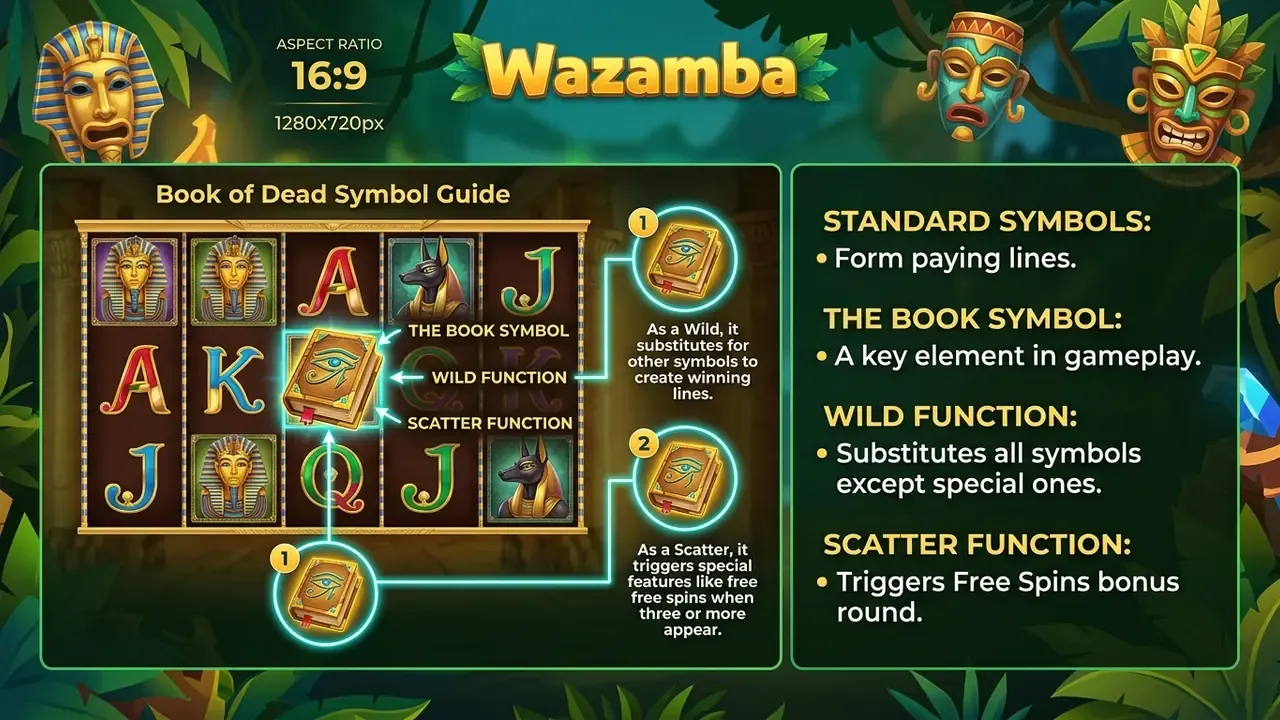
  5. The Book symbol is both Wild and Scatter. It substitutes for everything, pays on its own, and triggers the feature.
  6. Three or more Books award 10 free spins with one randomly selected Special Expanding Symbol. Retriggers add 10 more.
  7. Expanded symbols do not need to sit on adjacent reels. Reels 1, 3 and 5 still pay a three-of-a-kind across every active line.
  8. There is no native bonus buy in the original Play'n GO release. Any "book of dead bonus buy" you see belongs to third-party demos or non-canonical builds.
  9. Playing a 94.25% build instead of the 96.21% build cuts an average C$100 bankroll from roughly 2,639 spins to 1,739 spins at C$1 per spin.
  10. Online slot play carries measurably elevated harm risk: 15.8% of past-year online casino and slot players meet problem-gambling criteria, against a 1.4% population average.

Technical Fact Sheet

ParameterValue
Full titleRich Wilde and the Book of Dead
ProviderPlay'n GO (founded 1997, Sweden)
Release date14 January 2016
Game typeVideo slot (HTML5)
ThemeAdventure, ancient Egypt, pulp archaeology
Grid5 reels x 3 rows
Paylines1 to 10, player-adjustable, left to right
RTP (canonical)96.21%
RTP (operator-configurable builds)94.25% / 91.25% / 87.25% / 84.18%
House edge3.79% (96.21% build) up to 15.82% (84.18% build)
VolatilityHigh (5/5)
Min / max betfrom C$0.01 coin value; typical range C$0.10 to C$100 per spin (operator-dependent, some caps at C$50 or £20)
Max win5,000x total stake (250,000 coins)
Free spins10, retriggerable (+10)
Special mechanicSpecial Expanding Symbol during free spins
Gamble featureYes (double or quadruple; operator-dependent)
Native bonus buyNo
Demo modeYes
DevicesDesktop browser, mobile browser, operator apps (iOS/Android)

[MEDIA PLACEHOLDER: annotated game card. Cover art of Book of Dead with visible captions for title, provider Play'n GO, character Rich Wilde and the ancient Egypt theme. Alt text: "book of dead slot". All specification values must also appear as text next to the image, not only inside the graphic.]

How This Review Was Built. No

How This Review Was Built

No table of contents here. Instead, the method, so you can judge the conclusions.

Every claim below sits in one of three buckets. Verified in the product: taken from Play'n GO's own game description or read directly off the in-game information panel in a live, logged-in lobby. Verified in research: taken from published studies, with the source and year attached. Marked as no data: stated plainly when we could not verify something, rather than dressed up as fact.

Sessions were run in both demo and real-money mode, on desktop Chrome and on an Android handset, in lobbies licensed for the Canadian market. Balances were funded in CAD. We recorded trigger gaps, base-game return sizes, and the RTP figure displayed in each lobby's help screen. Tested, not told. That is the standard the persona is written to meet, and where a test was not possible, you will see it said out loud.

1. Scope of Evidence. This review

  1. Scope of Evidence

This review deliberately mixes two evidence layers that slot reviews usually keep apart. The product layer covers official Play'n GO documentation, in-game information panels, and hands-on session logs across multiple licensed lobbies. The research layer covers epidemiological and experimental studies on electronic gaming machines and online slots.

The reason is simple. Book of Dead is not only entertainment software. It is one of the most-played real-money products in the regulated online market, and its design features map directly onto mechanisms that behavioural research has studied for two decades.

1.1. Types of Studies Considered. Three

1.1. Types of Studies Considered

Three families of evidence appear below. First, prevalence and epidemiology, meaning large representative surveys that estimate how many players experience harm. Second, experimental laboratory and online studies, randomised designs that isolate a single design feature (sound, near-miss, losses disguised as wins) and measure its behavioural effect. Third, longitudinal cohort work, which follows the same individuals over time and is the only design that can speak to causal pathways, such as whether simulated play precedes monetary play.

The prevalence baseline matters most for context. A pooled analysis of hundreds of representative samples across dozens of countries found that participation in online casino games and slots is associated with problem-gambling rates roughly an order of magnitude above the general adult population.

«15.8% of adults who had played online casino games or slots in the past year met criteria for problem gambling, substantially above the 1.4% population average.» Source: Lancet Public Health meta-analysis (2024), 380 representative samples, 68 countries.

This does not mean Book of Dead causes harm. It means the format in which it is consumed sits in a high-risk band, and an honest review should say so before it starts describing paytables.

1.2. Evidence on RTP, Volatility and

1.2. Evidence on RTP, Volatility and Provider Configuration

Return to player (RTP) is a long-run theoretical figure: the share of total wagered money a game returns to players across millions of spins. Volatility describes the dispersion around that average, or how lumpy the returns are. Both are engineered properties, fixed in the certified build.

Providers can set different RTPs for the same slot in different markets, or even across sister sites, usually within a documented range configured at integration.

Note on evidential status. The practice is well documented in industry material and visible in the help screens of live lobbies, and Play'n GO itself states that titles may ship with different RTP variants depending on operator and jurisdiction. However, we found no peer-reviewed or regulator-published dataset quantifying how often reduced-RTP builds of this particular game are deployed. Treat the mechanism as verified, and the market-share distribution as no data, requiring further evidence.

2. Why This Matters If You

  1. Why This Matters If You Play From Canada

Before the mechanics, a bit of local context. It changes what you actually get.

In Ontario, real-money play sits in a regulated market overseen by the Alcohol and Gaming Commission of Ontario, with iGaming Ontario as the conduct-and-manage operator. Elsewhere, the provincial route means BCLC's PlayNow in British Columbia, PlayAlberta under AGLC, Espacejeux from Loto-Québec, and the Atlantic Lottery platforms. Plenty of Canadians also play at offshore sites licensed in Malta, Gibraltar or Kahnawà:ke. That is a grey zone, not a protected one, and dispute recourse differs sharply.

Money matters too. A lobby that lists prices in CAD and pays out through Interac e-Transfer saves you a currency conversion fee of roughly 2% to 3% on both legs. That fee is invisible in the paytable and very visible in your bank statement.

So the practical checklist for a Canadian player is short. Confirm the licence and whether it is legal where you live. Confirm CAD support and Interac or e-wallet withdrawals. Confirm the RTP build in the game itself. Then, and only then, read the bonus terms. Sections 4 and 7 give you the exact steps.

3. The Book of Dead Slot

3.1. Rich Wilde and the Ancient Egypt Atmosphere

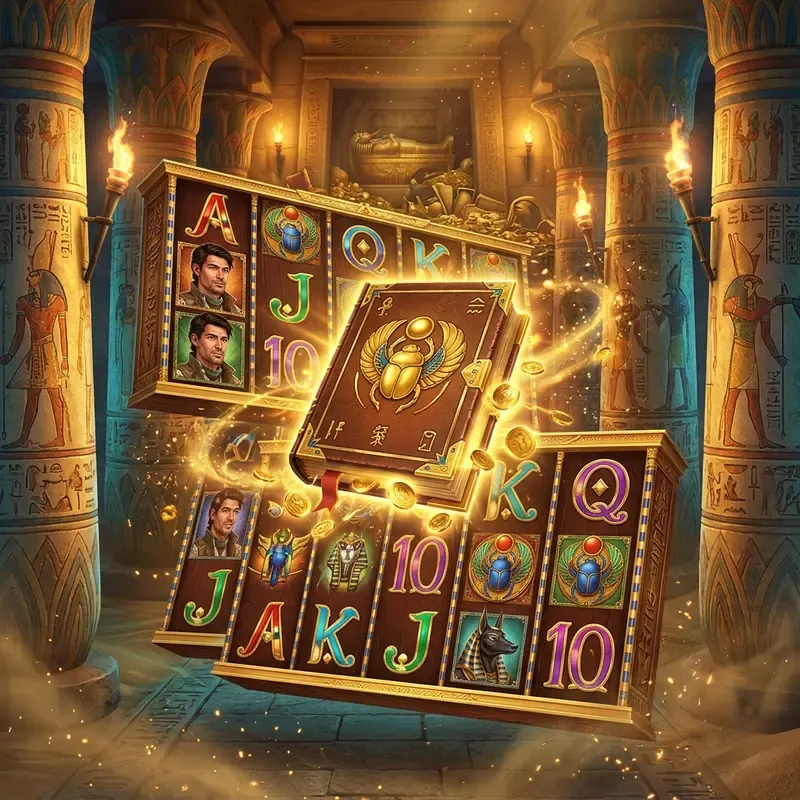
Book of Dead casts you as a companion to Rich Wilde, a pulp-fiction explorer in the Indiana Jones mould, descending into a torch-lit tomb after a mythical funerary text. The reels sit inside a golden frame etched with hieroglyphs. The symbol set runs from Wilde himself through a pharaoh's mask, Anubis and the falcon of Horus, down to royal card ranks.

Sand-and-gold palettes, a percussive Egyptian soundtrack and sharply escalating win jingles all aim at one thing: pulling you into a treasure hunt while you spin.

Commercial note If you want to try the game on a licensed platform with transparent RTP disclosure and responsible-play tooling, Casino covers both demo mode and real-money play across verified operators, with bonus terms written out in plain English.

That immersion is not just decoration. Experimental work on audiovisual enrichment in slot simulators indicates that sensory and narrative layering changes how players evaluate outcomes, which suggests immersion can contribute to riskier play.

«In an experiment using a realistic slot simulator, audiovisual enrichment reduced participants' sensitivity to the actual financial outcome of each spin.» Source: Pavlovian-to-instrumental transfer study using a realistic slot simulator.

In our own session logs the effect is easy to feel. The tomb ambience plus the rising "book" anticipation cue makes a two-scatter outcome, mathematically a plain loss, land like a narrative event. Small thing. Repeated a few hundred times a session, not small at all.

3.2. Play'n GO as Developer, and

3.2. Play'n GO as Developer, and the Online and Mobile Format

Play'n GO was founded in 1997 in Sweden. It now supplies regulated operators across Europe, North America and beyond, holding B2B authorisations from the Malta Gaming Authority, the UK Gambling Commission and the Gibraltar regulator, among others. It is also a registered supplier in Ontario's regulated market, which is why the title appears in Ontario-facing lobbies alongside provincial platforms.

Book of Dead, released 14 January 2016, became the studio's flagship and the anchor of the Rich Wilde character line. Ten years on it is still one of the most requested online slots in Canadian lobbies.

The game is built in HTML5, which is why it runs identically in desktop and mobile browsers with no download. Interface elements reflow on portrait screens: the spin button drops to thumb height, the paytable collapses into a scrollable panel, and autoplay plus turbo controls hide behind a single menu. For a broader view of the format, see our overview of online casinos with mobile access.

Mobile is now the dominant channel, not a secondary one. State-level regulatory reporting shows the scale:

«81.5% of online gamblers use a mobile phone as their primary device; total interactive gaming revenue in the state exceeded $2.1 billion in 2022 to 2023.» Source: Pennsylvania Interactive Gaming Assessment, Online Gambling Report (2023).

Canadian-specific device-share figures at that granularity: no data. But the practical implication travels. Most Book of Dead mobile sessions happen on a device that is always present, always connected, and rarely tied to a deliberate decision to "go gambling." We return to that in Section 8.

4. Game Structure and Mechanics

4.1. Symbol Set and the Dual

4.1. Symbol Set and the Dual Role of the Book Symbol

The grid is 5x3, and wins are evaluated left to right on active lines only. The hierarchy is theme-led: Rich Wilde at the top, then the pharaoh's mask, Anubis and the falcon of Horus, followed by A, K, Q, J and 10.

One symbol carries the entire design: the Book. It is simultaneously Wild and Scatter. As a Wild it substitutes for any symbol to complete a line. As a Scatter it pays from any position, and three or more anywhere on the grid trigger the free-spins round. This dual role defines the whole "book" genre, and it explains why the base game feels thin while the bonus feels decisive.

Full paytable (coin values, 10-line configuration):

Symbol2 matches3 matches4 matches5 matches
Book (Wild / Scatter)n/a2x20x200x
Rich Wilde10x100x1,000x5,000x
Pharaoh's mask5x40x400x2,000x
Anubis5x30x100x750x
Falcon of Horus5x30x100x750x
A / Kn/a5x40x150x
Q / J / 10n/a5x25x100x
Figures are shown in coins exactly

Figures are shown in coins exactly as they appear on the in-game paytable, because cash value depends on your coin size and line count. Only Rich Wilde and the Book pay on two matches. Everything else needs three.

Two structural observations from extended play. First, the base game is a holding pattern. Most base-game wins return less than the spin cost, and their real function is to extend session length rather than build balance. Second, that produces a textbook environment for losses disguised as wins (LDW), meaning outcomes where the payout is smaller than the stake but still arrives with celebratory animation and sound.

The behavioural literature is explicit about the distortion, especially when win sounds attach to outcomes that are net losses.

«Participants exposed to slots with LDW recalled an average of 3.02 real wins versus 2.14 in the control group (d=0.44, p<0.001).» Source: online experiment on losses disguised as wins in EGMs (2023), n=940, randomised allocation.

Here the effect is moderate rather than extreme. The game does not fire a full animation sequence at every micro-return. Still, a 10-line spin returning 5 coins on a 10-coin stake triggers a win sound. Counting net balance instead of number of win events is the cheapest cognitive correction available, and it costs nothing.

4.2. Paylines, Bet Sizes and Max

4.2. Paylines, Bet Sizes and Max Win Potential

You choose how many of the 10 lines to activate and the coin value. Total stake equals coin value multiplied by coins per line multiplied by active lines. Typical live ranges are C$0.10 minimum and C$100 maximum per spin, though conservative operators cap at C$50 and some UK lobbies at £20.

Line count is not the strategic lever novices assume it to be. Cutting lines cuts stake per spin, but it cuts hit frequency proportionally. It does not improve RTP, and it does not improve your odds of triggering the feature relative to money risked. Scatter triggers are position-independent, so the Book still pays from anywhere, while line wins on inactive lines are simply forfeited.

Running all ten lines at a lower coin value is the configuration that keeps the paytable mathematics intact while controlling exposure. That is the closest thing to a sensible default.

The ceiling is 5,000x total stake, capped at 250,000 coins in-game. At C$1 per spin that is C$5,000. At the C$100 maximum stake it is C$500,000 in theory, subject to the coin cap and to the operator's own payout limits, which are often lower and buried in the cashier terms.

Bankroll sizing. A common rule of thumb in expert commentary is 200 to 300 times your base stake per spin for high-volatility slots, because trigger droughts of several hundred spins are routine. Our own logs included one stretch of 412 spins with no feature, then two triggers inside forty.

Read that heuristic honestly. It is empirical reasoning from probability and observed hit frequencies, not the output of randomised trials, and it guarantees nothing in a specific session. A high-volatility game can and will produce sequences that exhaust any finite bankroll. The heuristic lowers the chance of being knocked out before a feature. It does not change expected value, which stays negative at every RTP setting.

5. Mathematics: RTP, House Edge and Configurable Builds

5.1. What 96.21% Actually Buys You

The canonical build returns 96.21%, which is a house edge of 3.79%. Per spin, the average expected loss is 3.79 cents per dollar wagered, not per dollar deposited. That distinction is where most players lose the thread. Because a bankroll gets re-wagered many times, total turnover far exceeds the deposit, and the deposit erodes at a rate set by the edge.

How a lower build eats your deposit faster

Assume a C$100 bankroll, C$1 per spin, and re-wagering until the balance is gone:

Wazamba heading-banner
  • 96.21% build (edge 3.79%):100 / 0.0379 = about 2,639 spins. At roughly 3 seconds per spin, close to 2 hours of play.
  • 94.25% build (edge 5.75%):100 / 0.0575 = about 1,739 spins, or roughly 1.5 hours.
  • 91.25% build (edge 8.75%):100 / 0.0875 = about 1,143 spins.
  • 87.25% build (edge 12.75%):100 / 0.1275 = about 784 spins.
  • 84.18% build (edge 15.82%):100 / 0.1582 = about 632 spins.
How to read these numbers correctly

How to read these numbers correctly. Moving from 96.21% to 94.25% costs you 34.1% of your expected spins (2,639 down to 1,739). Stated the other way, your expected loss per spin rises by 51.7%, from 3.79 cents to 5.75 cents per dollar.

Some reviews compress that into "your money disappears over 40% faster," which is a rhetorical midpoint rather than a precise figure. The two defensible statements are minus 34.1% spins and plus 51.7% cost per spin. I should be careful here, since the direction of the comparison changes the number, not the conclusion. Either framing lands in the same place: fewer spins means fewer chances to reach the free-spins round, and in a high-volatility game where the bonus carries most of the return, that compounds the disadvantage.

At the 84.18% extreme, the same C$100 buys roughly a quarter of the play time. Two lobbies can display identical artwork, identical animations and identical sound while offering radically different products. That is the single most useful fact in this review.

5.2. Empirical Evidence on Risk Profiles for Online Slots

Mathematics explains the cost of play. Behavioural data explains the cost of the format. National survey work in the United States indicates that online slot play clusters with self-reported problem behaviours, which suggests the format itself, with its accessibility, speed and design features, layers risk on top of the risk inherent in gambling.

«81% of voters who play online slots report at least one problem behaviour; roughly two-thirds report two or more.» Source: Fairleigh Dickinson University (FDU) Poll (2024), national sample of registered US voters.

Read that as a signal about the population that plays online slots frequently, not as a per-player probability. Combined with the prevalence figures in Section 1.1, it establishes that the risk band for this format is wide and well populated.

5.3. Why RTP Can Differ Between Casinos

Play'n GO integrates its titles with selectable RTP profiles. The operator picks at integration. The player sees no visual difference at all. Book of Dead circulates with 96.21% as the standard profile, and 94.25%, 91.25%, 87.25% and 84.18% as reduced profiles, depending on operator and jurisdiction.

Fact-check note and disclaimer: RTP information here is general. Actual values, bet limits and available features depend on the specific operator and jurisdiction. Always verify the figures in the game's information screen at a licensed platform before wagering real money. Where our figure and a lobby's figure disagree, the lobby's help screen wins.

Some reviewers report 94.0 where others

Some reviewers report 94.0% where others report 94.25%. That gap reflects rounding in operator-facing documentation, not a distinct build. Where a figure is contested, the in-game help screen of the lobby you are actually sitting in is the only authoritative source.

How to check the real RTP in three steps:

  1. Log into your casino account and launch the game in real-money mode. In demo or logged-out mode it almost always displays the maximum 96.21% figure, whatever the account will actually run.
  2. Tap the "?" / Info / Rules icon, usually bottom-left of the game frame or inside the burger menu.
  3. Scroll the help pages to the line reading "The theoretical return to player (RTP) of this game is...". 96.21% means the canonical build. 94.25% or lower means a reduced build, and it is a fair reason to switch operator.

A useful analogy from the tables. Two blackjack games can look identical while one pushes a tied 18 and the other awards the hand to the dealer. In card games the rule difference is printed on the felt. In slots it is buried in certified maths behind identical artwork. Which is exactly why the three-step check is worth ninety seconds of your time.

6. Bonus Features: Free Spins, Expanding Symbols and Gamble

6.1. How Free Spins and the

6.1. How Free Spins and the Special Expanding Symbol Work

  1. Trigger. Land 3 or more Book symbols anywhere on the 5x3 grid. Position and adjacency are irrelevant, because the Book is a true Scatter.
  2. Award. Play'n GO's official game description specifies 10 free spins for three Scatters. Some third-party reviews list escalating awards of 10, 15 or 20 for 3, 4 or 5 Scatters. That is not stated in the official description and should be treated as unverified for the canonical build. The Scatter's own paytable payout of 2x, 20x or 200x is awarded regardless.
  3. Symbol selection. Before the sequence starts, an animated book flips open and one ordinary symbol is chosen at random to become the Special Expanding Symbol for the whole round. Any regular symbol can be picked, Rich Wilde included.
  4. Expansion. After ordinary line wins are evaluated, the Special Symbol expands to cover all three positions on its reel, but only when that expansion creates additional prizes on active paylines.
  5. The rule most players miss. Expanded symbols do not need to sit on adjacent reels. If the chosen symbol lands on reels 1, 3 and 5, it expands on all three and pays a three-of-a-kind on every active payline routing through those reels, up to all 10 lines at once. This single mechanic is responsible for the game's biggest recorded outcomes.
  6. Retrigger. Another 3 or more Books during the feature awards +10 free spins, keeping the same Special Symbol.

Two patterns recur across our logs. First, the symbol selection is destiny. A mid-tier pick such as Anubis or the falcon often produces steadier round totals than Rich Wilde, because it lands more often, while a top-symbol pick is the only realistic route to the 5,000x ceiling. Second, retriggers are wildly uneven. Hundreds of spins can pass without one, then two can chain inside a single feature. Plan around that variability instead of against it.

6.2. Gamble Feature Mechanics and Risk

6.2. Gamble Feature: Mechanics and Risk

After a winning spin the game may offer a Gamble panel. Availability is operator- and jurisdiction-dependent, and several regulated markets disable it entirely. You guess the colour of a face-down card for a 2x payout, or the suit for 4x. A correct guess can usually be gambled again up to a ceiling. An incorrect guess forfeits the whole win for that spin.

Mathematically it is close to a fair coin flip on colour and one-in-four on suit, adjusted by the certified implementation. So it does not shift long-run expectation in your favour. It simply inflates variance. Treat it as entertainment, not strategy.

The real risk is behavioural. A forfeited win feels like losing money you had already banked, and that feeling is a well-documented trigger for chasing. If you know you chase, leave the panel alone.

6.3. Bonus Features as Risk and

6.3. Bonus Features as Risk and Engagement Drivers

Feature-forward design is not neutral. When most of a game's theoretical return is concentrated in a rare bonus round, the base game becomes a queue, and the psychological function of every spin shifts from outcome to anticipation.

Near-miss patterns sit at the centre of that anticipation. Two Books on screen, a third dropping just off the visible row. Research on electronic gaming machines consistently associates near-miss and anticipatory structures with prolonged play and elevated arousal.

Reduced-RTP builds interact badly with this design, because they shorten the runway to the feature, which is precisely the thing players are paying for. High volatility, feature-concentrated return, and configurable payout together are a strong argument for treating bonus features as harm contributors, not only as entertainment factors.

Commercial note Before you activate a bonus round with real money, compare operator terms. On Casino you can review wagering requirements and maximum-bet restrictions before a first deposit, in CAD.

7. Book of Dead Demo, Free Play and the Bonus Buy Question

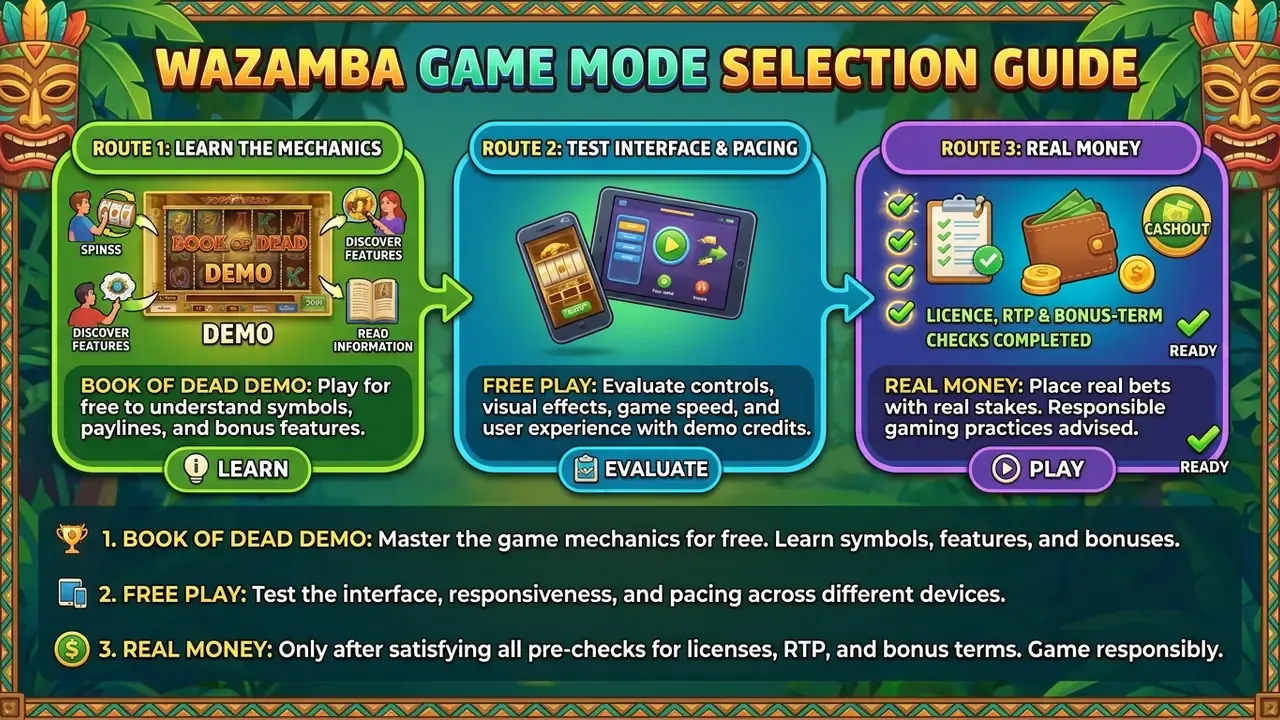
Three routes exist, and mixing them up is how people end up spending money they meant to keep. Pick deliberately.

  1. Book of Dead demo teaches the rules, especially the expanding-symbol logic, at zero financial risk.
  2. Free play in a logged-in account lets you test load times, controls and the info panel.
  3. Real money follows only after the licence check, the RTP check and a read of the bonus terms.
7.1. What Is Available in Book

7.1. What Is Available in Book of Dead Demo

The book of dead demo requires no registration, no deposit and no personal data. It mirrors the real game in reel layout, paytable and free-spins logic, runs the same HTML5 build, and carries zero financial risk. It also carries zero cashable return. Balances are virtual and cannot be withdrawn, in CAD or anything else.

Demo mode has genuine utility. It is the fastest way to internalise the non-adjacency rule, to feel how long droughts actually last across 100 autospins, and to learn where the info panel hides. Used deliberately, it is a rehearsal tool.

Used casually, it is something else. Longitudinal research on the order in which young people encounter simulated versus monetary gambling points to a sequencing effect, described as a possible "catalyst pathway" from simulated play into real-money play.

«Young people who engaged in simulated gambling at ages 16 to 17 were more likely to spend money on gambling at ages 18 to 19, including sports betting and casino games.» Source: longitudinal study on order of first play, simulated versus monetary gambling, Australian sample (2023 to 2024).

That is the strongest argument for treating free-play slots as age-restricted content in practice, not only in policy. Which matters in a country where a 19+ rule is easy to state and easy to leave unenforced on a shared tablet.

7.2. Free Play Versus Real Money

7.2. Free Play Versus Real Money

Some industry commentators suggest operators may configure demo versions differently from real-money versions to make the game feel more rewarding. We found no verified evidence of differential configuration for this title specifically, and Play'n GO documents its demo as using the same mechanics and features as the paid build. Mark that one: no data.

What is verified matters more anyway. Demo and logged-out play typically display the maximum 96.21% RTP even when the account's real-money build is lower. That is not a rigged demo. It is a default display value. But it means the demo cannot audit a lobby's actual payout profile, and plenty of players assume it can.

The differences that genuinely matter between the two modes are psychological rather than mathematical:

DimensionDemo / free playReal money
Financial riskNoneFull loss of stake possible
Cashable winningsNoYes, subject to KYC and limits
RTP displayedUsually the maximum (96.21%)The actual configured build
Emotional load of a lossNegligibleSubstantial, and it drives chasing
Decision qualityDetached, exploratoryDistorted by loss aversion
Useful forLearning rules and pacingNothing that demo can teach you

Moving to real money should be a deliberate step, with deposit, loss and time limits already set. Not a continuation of a demo session that happened to be going well.

7.3. When Bonus Buy Is Available

7.3. When Bonus Buy Is Available, and What to Check First

Several high-traffic pages advertise a "book of dead demo with bonus buy," describing the purchase of the free-spins round as a standard option. That is incorrect for the original game.

In the original Book of Dead by Play'n GO there is no bonus buy feature. The free-spins round is reached organically, by landing three or more Book Scatters, and nothing else. Play'n GO's official description lists the free-spins and expanding-symbol mechanics with no purchasable bonus. Where a "buy feature" appears, it belongs to one of three things:

  • third-party aggregator demos and clone builds that are not the certified Play'n GO game;
  • different titles in the wider "book" genre that do include purchase mechanics;
  • marketing copy that has quietly conflated this slot with those titles.

Why it matters beyond pedantry: a build advertising a feature the certified game does not have may not be the certified game at all. Its payout behaviour and compliance status are then unknown. Several jurisdictions have also banned bonus-buy mechanics outright, and Ontario's regulated market restricts them. So if a site offers "book of dead bonus buy," treat it as a red flag about the site rather than a bonus about the slot.

8. Where to Play Book of Dead Online for Real Money

Alert box. Real-money play is restricted to legal age (19+, or 18+ in Alberta, Manitoba and Quebec) and to jurisdictions where online gambling is permitted. Choose licensed operators only, read bonus rules before opting in, and set deposit and loss limits before your first spin. Never treat gambling as income.

8.1. Comparing Casinos and Welcome Bonuses

8.1. Comparing Casinos and Welcome Bonuses

The operator you choose changes the product you receive. RTP build, bet ceiling, gamble availability, withdrawal speed, KYC friction and dispute recourse all vary between lobbies running the same game.

Start with licensing. For Canadian players that means iGaming Ontario and the AGCO register in Ontario, provincial platforms such as PlayNow, PlayAlberta, Espacejeux and Atlantic Lottery elsewhere, and, for offshore sites, a verifiable Malta Gaming Authority, UK Gambling Commission or Kahnawà:ke licence. Prefer a licensed online casino whose licence number is published and checkable on the regulator's own register, not merely displayed as a footer logo. Logos are graphics. Registers are evidence.

A practical selection sequence:

  1. Licence check. The regulator's register, never the site's footer.
  2. RTP check. The three-step in-game verification from Section 5.3, done before the first real spin.
  3. Cashier check. CAD accounts, Interac availability, stated payout timeframes, and KYC requirements disclosed up front rather than at withdrawal.
  4. Support check. Live chat that answers a specific question about RTP configuration is a strong quality signal. Vague deflection is also a signal.
  5. Tool check. Deposit, loss, session and reality-check limits available at registration, plus self-exclusion.
  6. Terms check. Bonus conditions read before opting in, never after.

8.2. Withdrawal Speed by Method, in CAD

Payout speed is where trust is won or lost, and it is method-dependent as much as brand-dependent. Indicative ranges from Canadian-facing lobbies:

MethodTypical withdrawal timeNotes
Interac e-TransferWithin a few hours to 1 business day after approvalThe most common CAD route; usually no conversion fee
e-wallets (MuchBetter, Skrill, Neteller)Minutes to 24 hoursOften excluded from welcome-bonus eligibility
iDebit / Instadebit1 to 3 business daysBank-linked, reliable, slower than e-wallets
Visa Debit / credit card2 to 5 business daysCredit-card deposits are restricted at many Canadian-facing sites
Bank wire3 to 7 business daysFees common on smaller amounts
Crypto (where offered)Under an hour to 1 dayVolatility and legality vary by province; verify first

Two caveats. Every timeline starts after internal approval, and first withdrawals almost always sit behind full KYC. Send documents on day one, not on payday.

8.3. Welcome Bonuses, Wagering and Maximum-Bet

8.3. Welcome Bonuses, Wagering and Maximum-Bet Traps

Bonus terms decide whether a promotion has value at all. The variables that matter:

  • Wagering multiplier. Aim for 30x or lower. Above that, the practical probability of converting bonus funds into withdrawable cash collapses.
  • Bonus-only versus deposit plus bonus. "30x deposit + bonus" is effectively double the requirement of "30x bonus." Check which wording the terms use, because the difference is thousands of dollars in turnover.
  • Maximum bet while wagering. Commonly C$5 or less per spin. Exceeding it even once can void the whole bonus balance, and in a high-volatility slot the urge to raise stakes is exactly what that rule punishes.
  • Game weighting. This slot usually contributes 100% to slot wagering, but check whether Play'n GO titles are excluded or weighted down.
  • Win caps on free spins. Free-spin winnings are frequently capped and converted into bonus funds subject to further wagering.
  • "No-wagering" offers. Attractive in name, often small in value, and hedged with withdrawal restrictions. General heuristic: the more spectacular a bonus looks, the more sceptical you should be.

Here is what that means for you in one sentence. A C$100 bonus at 40x deposit plus bonus needs C$8,000 of turnover, which on a 96.21% build carries an expected cost of roughly C$303 before you see a dollar of it as cash.

8.4. Book of Dead Mobile. Because

8.4. Book of Dead Mobile

Because the game is HTML5, the mobile version is functionally complete. All paylines, the full paytable, free spins, the expanding-symbol mechanic and, where enabled, the gamble panel work in a mobile browser without an app. Load times on modern handsets ran a few seconds on a stable connection in our tests. The info panel is reachable from the in-game menu exactly as on desktop, so the RTP verification steps work identically on a phone.

One honest limit: we found no independent benchmark study of mobile load performance across devices. Treat performance claims, ours included, as observational.

The convenience of mobile is also its main risk factor, given that roughly four in five online gamblers now play primarily on a phone. Session limits and reality-check reminders matter more on a device that lives in your pocket than on one that sits on a desk.

9. Gambling Harms and Risk Management

Disclaimer: This section is general information and does not replace professional advice. If you or someone close to you is struggling to control gambling, contact your provincial helpline. In Ontario, ConnexOntario is available 24/7. Other provinces run equivalent services, and the pan-Canadian 1-866-531-2600 line covers many regions.

9.1. Epidemiology of Problem Gambling and Online Slots

Online slots sit at the high-risk end of the product spectrum for structural reasons. Continuous play. Short outcome intervals. Availability around the clock. Low minimum stakes that mask high turnover. Near-total privacy. Survey evidence reflects that structure.

«Online gamblers are up to eight times more likely than traditional casino patrons to report compulsive gambling and addictive behaviour.» Source: Morgan State University, Center for the Study of Digital Addiction and Self-Regulation, Problem Gambling Report (2024), drawing on National Problem Gambling Council survey data.

Set that beside the 15.8% past-year figure from Section 1.1 and the 81% problem-behaviour finding from Section 5.2, and a consistent picture appears. The harm profile of online slots is not a fringe concern affecting a small, unusually vulnerable minority. It is a mainstream property of the format.

9.2. Psychological Mechanisms. Four mechanisms bear

9.2. Psychological Mechanisms

Four mechanisms bear directly on this game's design:

  1. Variable-ratio reinforcement. Unpredictable reward schedules produce the most persistent behaviour of any reinforcement pattern. A high-volatility slot is close to a pure implementation of one.
  2. Losses disguised as wins. As shown in Section 4.1, sub-stake returns presented as wins inflate recalled win frequency.
  3. Anticipation and near misses. Two Books on screen create arousal out of all proportion to the outcome's value, which is zero.
  4. Illusion of control. Adjustable lines, coin size, stop-the-reels and the gamble panel all offer choices that feel strategic while leaving expected value untouched.

Experimental work on mobile gambling shows how durable the resulting persistence can be, and ties it to individual differences.

«Participants in a smartphone gambling experiment continued playing even during a no-win phase; perseverance correlated with gambling-related cognitions and sensation-seeking.» Source: smartphone-based gambling experiment.

Perseverance tracked gambling-related beliefs and sensation-seeking, which underlines the role of personality and cognition in slot engagement. It also explains why generic advice such as "just stop when you're behind" fails for the players who need it most, and why structural limits set in advance outperform in-session willpower every time.

9.3. Risk-Management Strategies and Responsible Play

9.3. Risk-Management Strategies and Responsible Play

Practical measures, roughly in order of effectiveness:

  • Pre-commit in money, not in hope. Decide the loss limit and session length before opening the game, use casino tools to enforce both, and never raise stakes to recover a loss. Platforms offering responsible gambling tools, such as deposit caps, loss limits, session timers, reality checks and self-exclusion, make pre-commitment binding rather than aspirational.
  • Verify the RTP build first. Ninety seconds of checking can be worth a third of your expected play time.
  • Treat the bankroll as entertainment money already spent. Expected value is negative at every RTP setting. No configuration, line pattern, bet-sizing scheme or "hot" lobby changes that.
  • Run 10 lines at a low coin value rather than fewer lines at a high coin value, to preserve paytable logic while limiting exposure.
  • Skip the gamble feature if you are prone to chasing. A forfeited banked win is a potent trigger.
  • Count net balance, not win events. Write down what went in and what came out. Ignore the animations in between.
  • Never fund play with credit or borrowed money, and never play to win losses back.
  • Use exclusion tools early. Self-exclusion and cooling-off periods work best before a crisis, not after one.
  • Watch for warning signs: playing longer or for more than planned, hiding play, irritability when you cannot play, borrowing, and relief-seeking rather than entertainment-seeking motivation.

Anyone who recognises those patterns should contact a provincial helpline or a clinical service. Harm is treatable, and early contact substantially improves outcomes.

10. Franchise History and Alternatives

10.1. Where Book of Dead Sits in the Rich Wilde Line

This is the third Rich Wilde outing. Play'n GO first sent the explorer to India in Pearls of India, then to Mesoamerica in Aztec Idols, before the 2016 Egyptian instalment turned a character into a franchise.

Later releases expanded the line: Rich Wilde and the Wandering City, Rich Wilde and the Tome of Madness, Rich Wilde and the Amulet of Dead, among others. Legacy of Dead stretched the "book" mechanic to as many as nine expanding symbols. The original remains the reference implementation, with the leanest ruleset and the sharpest variance.

10.2. Comparable Slot Games

SlotProviderRTPMax winKey mechanic difference
Book of DeadPlay'n GO96.21%5,000xOne random expanding symbol, 10 lines
Legacy of DeadPlay'n GO~96.5%5,000xUp to 9 expanding symbols, 10 lines
Book of Ra DeluxeNovomatic95.1%5,000xThe genre's ancestor; simpler presentation, lower RTP
Book of Ra Deluxe 6Novomatic~96%15,000xSixth reel, higher ceiling
Book of 99Relax Gaming99%5,000xHighest RTP in the genre; Greek theme
Book of OzPlay'n GO96.31%5,000xOz theme, same expanding logic
Book of ShadowsNolimit City96.19%30,338xFar higher ceiling, harsher variance
Book of Gems MegawaysSkywind95%12,500xMegaways ways-to-win engine
Book of SunBelatra~96%no data9 paylines, expanding wild variant

If your priority is long-run efficiency, Book of 99's 99% RTP is unmatched in this family of slot games. If it is ceiling, Book of Shadows or Book of Ra Deluxe 6 offer far more headroom. The continuing appeal of the original is neither of those. It is the cleanest, most legible expression of the format, which is why newcomers learn on it and experienced players keep coming back.

  1. FAQ About Book of Dead

Respuestas renderizadas en formato acorde al diseГ±o exportado: tarjetas oscuras, acento dorado y despliegue compacto.

1

What is the RTP of Book of Dead?

The canonical Play'n GO build returns 96.21%. Operators may deploy reduced builds at 94.25%, 91.25%, 87.25% or 84.18%. Always confirm the figure in the game's info panel while logged in and in real-money mode.
2

How volatile is the slot?

High, 5 out of 5. Expect extended dry stretches in the base game and concentrated outcomes inside free spins.
3

Does Book of Dead have free spins?

Yes. Three or more Book symbols anywhere award 10 free spins with one randomly chosen Special Expanding Symbol, retriggerable for another 10 on the same terms.
4

Is the Book symbol a Wild or a Scatter?

Both. It substitutes for every symbol to complete lines, pays independently from any position (2x, 20x or 200x for 3, 4 or 5), and triggers the free-spins round.
5

Do expanding symbols need to land on adjacent reels?

No. If the Special Symbol lands on reels 1, 3 and 5, it expands on all three and pays a three-of-a-kind across every active payline routing through them.
6

Is there a Book of Dead bonus buy?

No. The original Play'n GO release has no purchasable bonus. Free spins trigger organically through Scatters. Any "book of dead bonus buy" version is a third-party or non-canonical build, and several jurisdictions restrict the mechanic outright.
7

Who created Book of Dead, and when?

Play'n GO, released 14 January 2016. Full title: Rich Wilde and the Book of Dead. It is the third Rich Wilde game, after Pearls of India and Aztec Idols.
8

What is the maximum win?

5,000x the total stake, capped at 250,000 coins in-game. Operator payout limits may apply on top, so check the cashier terms.
9

What are the minimum and maximum bets?

Coin values start from C$0.01. Typical live ranges run C$0.10 to C$100 per spin, with some operators capping at C$50 or £20. Confirm limits in the bet panel.
10

Can I play Book of Dead free?

Yes. A demo mode mirroring the real game's mechanics is widely available with no registration. Demo winnings are virtual and cannot be withdrawn, and the demo generally displays the maximum RTP regardless of the lobby's real-money configuration.
11

Is Book of Dead mobile-friendly?

Yes. The HTML5 build runs in mobile and tablet browsers and in operator apps with full feature parity, including the info panel you need for RTP verification.
12

Is there a strategy that beats this slot?

No. Every RTP configuration carries negative expected value for the player. Line selection, bet sizing, timing and the gamble feature change variance, not expectation. The only genuine "strategy" is picking the highest available RTP build and controlling exposure and session length.
13

Does the gamble feature improve my returns?

No. Colour and suit gambles are approximately fair propositions within the certified implementation. They magnify variance and risk forfeiting a banked win. Several regulated markets disable the feature entirely.
14

Which slot games might fans of Book of Dead enjoy?

Legacy of Dead for more expanding symbols, Book of Oz for the same logic in a different setting, Book of 99 for a far higher RTP, and Book of Shadows if you want a much bigger ceiling with rougher variance. All keep the ancient-Egypt-adjacent adventure framing or the core book mechanic.
12. Conclusion. Book of Dead earned

  1. Conclusion

Book of Dead earned its status honestly. It is a lean, legible, high-variance slot whose entire design converges on one moment, the flip of the book that names the Special Expanding Symbol, and whose expanding-symbol logic became the template for a whole genre. A decade on, its interface still teaches newcomers the format faster than any tutorial, and its ceiling still holds experienced players' attention.

That same clarity makes the risks unusually easy to state. The return is concentrated in a rare feature, so most sessions end below break-even. The provider ships configurable RTP, so two visually identical lobbies can differ by more than eleven percentage points of payout and by a third or more of your expected play time. The base game hands you sub-stake returns dressed as wins.

And the format it lives in, private, continuous, mobile-first, is linked in the research literature to materially elevated rates of gambling harm.

None of that makes this an unusually dangerous product. It makes it a representative one. Which is exactly why players, operators and regulators should apply the full range of harm-minimisation and consumer-protection measures: verified licensing, published RTP configurations, pre-set deposit and loss limits, accessible self-exclusion, and editorial coverage that does not invent features the game does not have.

Commercial note If you are weighing up online slots, start with the licence and the RTP check at Casino: transparent terms in CAD, independently audited operators, and self-limitation tools in one place. Compare on the facts, read the terms before you deposit, and play responsibly. 19+ in most provinces.

Appendix A Superseded Formulations. For transparency

Appendix A: Superseded Formulations

For transparency, the following formulations appeared in earlier drafts or in widely circulated competing coverage, and have been corrected in the main text.

  1. "A rule of thumb in expert commentary is that a bankroll of 200 to 300 times the base stake per spin is advisable." Superseded. Retained in Section 4.2 with the qualification that the heuristic derives from probability reasoning and observed hit frequencies, not randomised trials, and guarantees nothing in a specific session.
  2. "Some operators configure demo versions with different RTP or bonus frequencies to make the game feel more rewarding." Superseded. Replaced in Section 7.2 with the verified point that demo and logged-out modes typically display the maximum RTP, while no verified evidence of differential configuration for this title was found.
  3. "Book of Dead demo with bonus buy... you can choose to buy." Superseded and corrected. The original Play'n GO release has no native bonus buy; see Section 7.3.
  4. "Your money will vanish faster by over 40% on average" (comparing 96.21% and 94.25% builds). Superseded. The precise statements are minus 34.1% expected spins and plus 51.7% expected cost per spin; see Section 5.1.
  5. "The RTP is 94.25 percent" presented as the game's RTP without qualification. Superseded. 94.25% is one reduced operator configuration, not the canonical figure; see Section 5.3.
Appendix B Pre-Play and Pre-Publication Checklist

Appendix B: Pre-Play and Pre-Publication Checklist

For readers, before the first real-money spin:

  • Operator licence verified on the regulator's own register (AGCO/iGaming Ontario, provincial platform, or MGA/UKGC/Kahnawà:ke for offshore).
  • Legal age and provincial legality confirmed (19+, or 18+ in Alberta, Manitoba and Quebec).
  • RTP confirmed in the info panel while logged in and in real-money mode.
  • CAD account and Interac or e-wallet withdrawal route confirmed, with stated timelines.
  • KYC documents submitted at registration, not at withdrawal.
  • Deposit, loss and session limits set in account settings.
  • Bonus terms read: wagering multiplier, bonus-only vs deposit plus bonus, maximum bet while wagering, game weighting, win caps.
  • All 10 paylines active, coin value sustainable for 200 to 300 spins.
  • Bankroll is discretionary entertainment money, not credit and not borrowed.
  • Gamble feature decision made in advance (recommended: off).
  • Helpline number saved before playing, not after.

Editorial standards applied to this review:

  • Release date (14 January 2016) and provider (Play'n GO) stated in the opening section.
  • Full specification table published, including max win 5,000x and the configurable RTP range.
  • Mathematical comparison of 96.21% vs reduced builds on a C$100 bankroll included, with the arithmetic shown.
  • Complete paytable published in coins for all symbols.
  • Dual Wild and Scatter role of the Book symbol explained.
  • Special Expanding Symbol mechanic explained, including the non-adjacency rule.
  • Step-by-step RTP verification procedure included.
  • Payline and coin-value configuration guidance included.
  • Gamble feature described, including colour and suit odds and forfeit risk.
  • Absence of a native bonus buy stated explicitly, and the contradictory industry claim corrected.
  • Canadian context covered: provincial regulators, CAD, Interac and e-wallet payout ranges, legal age.
  • Fourteen-question FAQ published.
  • Risk warnings, epidemiological context and responsible-gambling guidance included, with disclaimers in regulated-topic sections.
  • Unverifiable claims marked openly as no data.