Online Blackjack in Canada: Rules, Strategy and Real Money Play

Reviewed and maintained by: the editorial analyst team at wazamba-site.com, with eight years of hands-on table testing, RNG audit verification and CAD payout timing across Canadian-facing platforms. Last updated: February 2026 · Audience: Canada (19+; 18+ in Alberta, Manitoba and Quebec)

"Over eight years evaluating online casino tables across Canadian-accessible platforms, one operational truth remains absolute: online blackjack is an exercise in contract terms, statistical house edges and strict risk boundaries, never a shortcut to guaranteed returns. Whether you play an RNG hand or sit at a live dealer stream watched from Vancouver or Toronto, treating every round as chance-based entertainment is the only sustainable approach."Reid Calloway, Independent Casino Analyst (editorial persona)

Blackjack is the one casino card game where your decisions genuinely change the numbers. Not the outcome of a single hand, but the long-run cost of playing. That is why it deserves a careful read before your first CAD deposit.

Provider

Evolution

RTP

99.4%
Online Blackjack in Canada Rules, Strategy
Why This Guide Matters Before You

Why This Guide Matters Before You Deposit

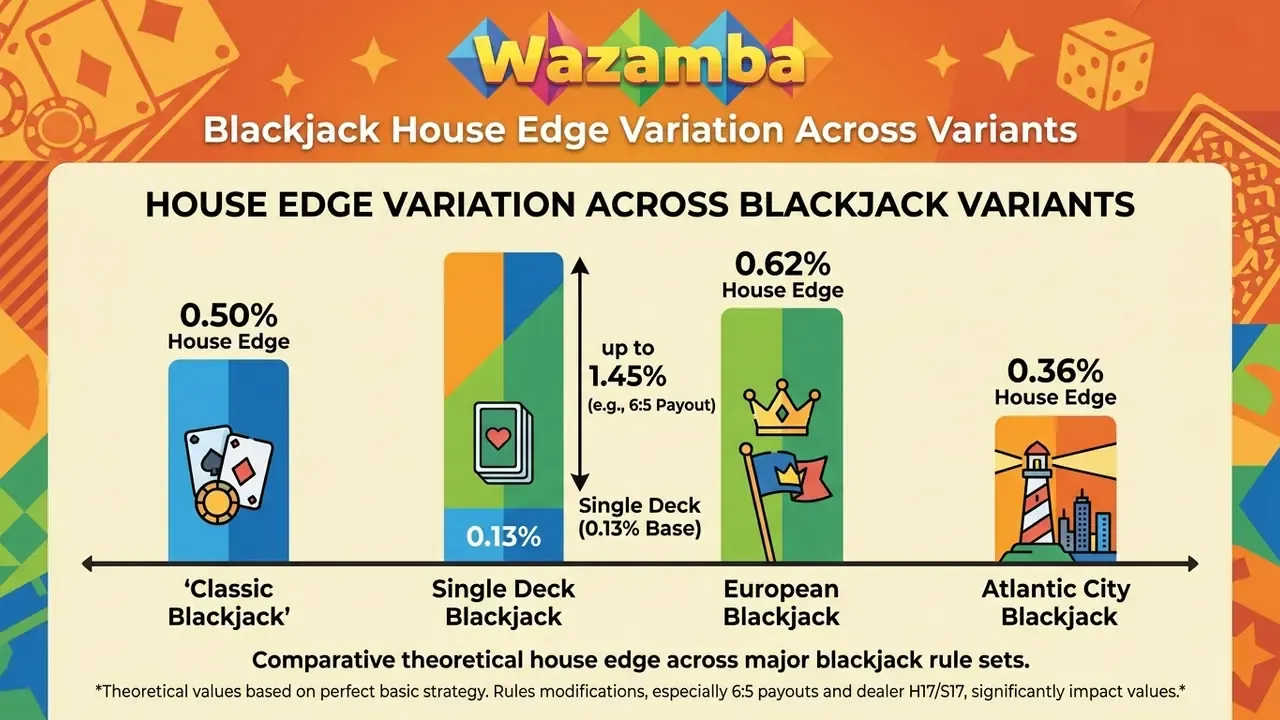
Here is the practical problem most Canadian players run into. Two tables can carry the same name, the same studio logo and the same felt colour, yet differ by more than a full percentage point in house edge. One pays 3:2 on a natural, the other pays 6:5. One stands on soft 17, the other hits it. Nothing on the lobby thumbnail tells you which is which.

Then comes the second layer: money movement. A blackjack win is only a win once it clears Interac and lands in your bank account. Verification holds, table-game bonus contribution rates and maximum-bet clauses all sit between you and that transfer, and they are written into terms most people scroll past.

So this guide works through four things in order. First, the rules and the card math, plainly. Second, the formats available in Canadian lobbies, from RNG blackjack games to live blackjack studios.

Third, the legal and payment reality by province, in CAD. Fourth, the risks: side bets, bonus wagering traps, and the limits you should set before you play a single hand for real money.

No promises of profit here. Just the fine print, read out loud.

1 What Is Blackjack and What

[1] What Is Blackjack and What Is the Goal of the Game?

In two sentences: Blackjack is a fixed-rule comparison card game in which you play only against the dealer, aiming for a total closer to 21 without exceeding it. Every rule variation, payout ratio and side bet on the felt changes the mathematical house edge, so reading the table rules is part of playing the game.

Blackjack is a fixed-rule card game where a player competes directly against the house, represented by the blackjack dealer, to build a hand total closer to 21 than the dealer's hand without exceeding 21. Canadian players typically meet it inside a licensed online casino lobby, split between software-dealt tables and live-streamed studio tables. A player's hand that surpasses a total of 21 busts immediately, which means an automatic loss of the wager regardless of the dealer's subsequent cards. Winning requires one of three things: a higher total than the dealer, a dealer bust while your total remains at or below 21, or an initial two-card natural combination when the dealer does not hold one.

In a standard online setting, a

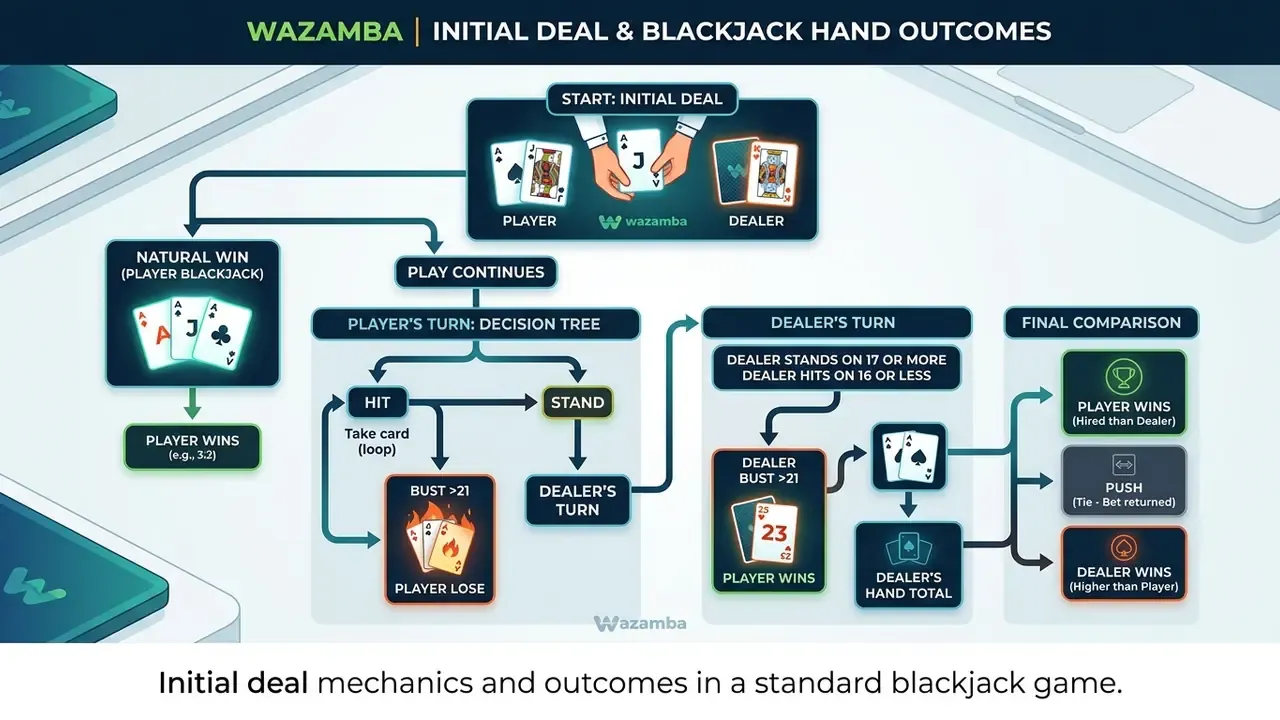
In a standard online setting, a single hand begins when the player receives two cards after placing a base bet. The dealer also receives two cards, typically one face up and one face down (the hole card). If a player is dealt an Ace and a ten-value card as their first two cards, the player has blackjack, a "natural", and receives an immediate payout, traditionally 3:2. The exception: if the dealer also holds a natural 21, the round becomes a push, or tie.

Land-based venues describe the game identically. Shoes containing two, six or eight decks, all player cards dealt face up, and a single objective of finishing closer to 21 than the dealer without breaking. Online software simply automates the shoe, the shuffle and the settlement math.

2 Card Values and the Blackjack

[2] Card Values and the Blackjack Combination

Short version: Card values in blackjack are fixed and suit-independent, with the Ace acting as either 1 or 11. Only a two-card 21 (Ace plus a 10-value card) qualifies as a natural and earns the enhanced payout.

In all casino blackjack variants, card values follow a strict numeric assignment regardless of suit:

  • Number cards (2 to 10):valued exactly at their face value.
  • Face cards (Jack, Queen, King):each face card counts as 10 points.
  • Ace:operates flexibly as either 1 or 11 points, depending on which value benefits the hand total without pushing it past 21.
When an Ace counts as 11

When an Ace counts as 11, the hand is classified as a "soft hand" (for example, Ace plus 6 equals soft 17), which lets the player take another card without immediate risk of busting. If drawing a high card would take the total beyond 21, the Ace automatically reverts to a value of 1, and the hand becomes hard.

Mathematically, an ordinary 21 formed by three or more cards (say 7 + 8 + 6) is distinct from a natural two-card blackjack combination. An ordinary 21 still beats lower dealer totals, but only the two-card version triggers the enhanced 3:2 payout ratio under standard rules. (Updated source attribution) Combinatorial research indicates that the probability of being dealt a natural blackjack from a freshly shuffled single deck is approximately 4.83%, or roughly once every 21 hands, which makes it a distinct, high-value event rather than a routine occurrence.

«The probability of receiving a natural blackjack is roughly 4.83%, approximately once every 21 hands from a standard shuffled deck.» — Georgia Tech Probability Analysis, combinatorial calculation based on a standard 52-card deck. Verification math: (4 ÷ 52) × (16 ÷ 51) × 2 = 128 ÷ 2,652 ≈ 4.826%.

One further detail matters at split tables. If you split a pair of Aces and then draw a 10-value card, most rule sets score the hand as an ordinary 21, not a natural blackjack, so it pays 1:1 rather than 3:2. Small clause, real money.

3 When a Player Wins, Loses

[3] When a Player Wins, Loses, or Pushes

In two sentences: Every blackjack round resolves into one of four settlement states. Knowing the payout attached to each state is what turns table rules into an expected-value calculation.

A round of online blackjack ends in one of four distinct statistical outcomes based on final hand values:

  1. Player win (1:1 payout): the player's final hand total is closer to 21 than the dealer's total, or the dealer busts above 21 while the player remains active.
  2. Natural blackjack win (3:2 payout): the player holds an Ace and a 10-value card on the first two cards, while the dealer does not hold a natural. A $10 wager returns $15 in profit plus the original stake.
  3. Player loss (no payout): the player's total is lower than the dealer's non-busting total, or the player busts during their turn. If a player busts, the bet is collected immediately, even if the dealer subsequently busts as well.
  4. Push or standoff (tie): both the player and the dealer finish with identical non-busting totals, or both hold natural blackjacks. The initial bet returns to the player bankroll with zero profit or loss.

Under standard regulatory guidelines across Canadian provinces, operators must disclose payout tables for each table before a player places a wager. Certified games are also required to present the same odds and payout percentages in demo mode as in real-money mode, which is why practice play counts as a valid rehearsal of table math.

[4] Blackjack Rules: How a Hand Unfolds

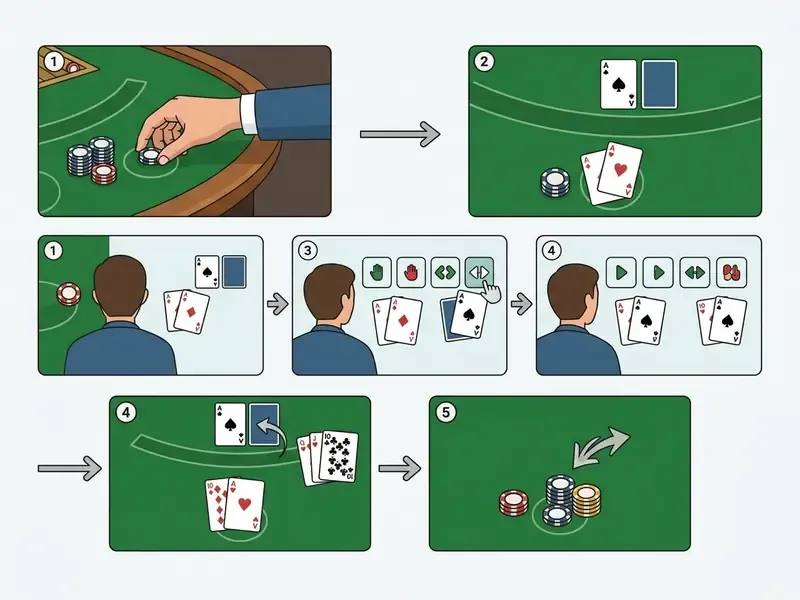
In two sentences: Every hand follows the same five-stage operational sequence, from wager placement to automated settlement. Memorising that sequence prevents mis-clicks during the short decision windows used by live tables.

A standard round of online casino blackjack follows a fixed, five-stage sequence that governs every wager from initial deal to settlement. The game moves predictably through player wagering, card dealing, decision loops, automated dealer drawing rules and final hand comparison.

The process begins when a player

The process begins when a player selects a chip denomination and places a valid wager within table limits. Once confirmed, the system or dealer distributes two cards face up to the player, while dealing one card face up and one card face down to the house. If the dealer's visible face-up card is an Ace or a 10-value card, the house peeks at the hole card to check for an immediate natural before player actions commence. Once all players have acted, the dealer reveals the hole card and must draw until reaching a fixed total, in most rule sets hitting on 16 or less and standing on 17 or more.

The dealer, worth noting, has no choices at all. That fixed obligation is exactly what your own decisions are measured against.

5 Hit, Stand, and Choosing the

[5] Hit, Stand, and Choosing the Next Card

Quick read: Hit and stand are the two core actions available on every hand. The correct choice is dictated by bust probability, not intuition.

After evaluating their initial two cards against the dealer's face-up card, the player selects a primary action:

  • Hit: request another card to increase the total score. A player may hit repeatedly until reaching 21 or busting.
  • Stand: decline further cards, lock in the current total, and pass action to the next hand or to the dealer.

The decision to hit or stand is driven directly by bust probability. (Updated source attribution) Empirical mathematical analysis from Cleveland State University, based on combinatorial analysis of a standard 52-card deck, shows how sharply bust risk accelerates as a hard hand total increases:

Player Hard TotalProbability of Busting on the Next Hit
Hard 1240%
Hard 1348%
Hard 1459%
Hard 1561%
Hard 1679%
Hard 1777% (if hit)

«At hard 16 the probability of busting on an additional card reaches 79%, the most dangerous hit position in standard blackjack.» — Cleveland State University, combinatorial blackjack probability analysis (standard 52-card deck).

Because drawing a 10-value card happens

Because drawing a 10-value card happens with 30.7% frequency, hitting hard hands above 11 carries substantial inherent risk. The arithmetic is verifiable straight from deck composition: 16 of the 52 cards in a standard deck, four each of 10, Jack, Queen and King, carry a value of ten, and 16 ÷ 52 = 30.77%. In multi-deck shoes the ratio is identical, because each additional deck contains the same proportion of ten-value cards.

Note on offline versus online controls: in land-based casinos such as The Venetian in Las Vegas, touching the cards is prohibited on face-up tables, and every decision is communicated with hand signals. Tapping or scratching the felt behind the wager means hit; waving a flat hand horizontally over the bet means stand. Online interfaces replace those physical gestures with instant digital buttons, and live dealer tables enforce a 10 to 15 second countdown on each decision. Rushed clicks are a real cost line, not a stylistic quirk.

6 Double, Split, Insurance, and Surrender

[6] Double, Split, Insurance, and Surrender

In two sentences: Beyond hit and stand, four specialised moves let you increase, divide, hedge or abandon a wager. Three of them raise expected value in narrow situations; one of them, insurance, almost never does.

To optimise expected value in specific scenarios, standard blackjack rules grant players these specialised moves:

  • Double down:the player doubles the initial bet in exchange for receiving exactly one additional card, after which the hand automatically stands. Doubling is mathematically optimal on hard totals of 10 or 11 when the dealer displays a weak up-card such as a 5 or 6. Land-based rules cap the extra wager at the value of the original bet.
  • Split:if the first two cards are of equal rank (8-8 or Ace-Ace, for example), the player can pay an additional wager equal to the original bet and separate them into two independent hands. Basic strategy universally dictates splitting Aces and 8s, and never splitting 10s, 5s or 4s. Split Aces are usually limited to a one-card draw per hand.
  • Insurance:a side wager offered when the dealer shows an Ace, costing up to 50% of the original bet. It pays 2:1 if the dealer holds a natural 21. Game-theoretic expected-value analyses confirm that insurance carries a heavy house edge, roughly 7.47% in multi-deck games, and represents a negative expected value decision for non-counting players. Methodology note: the figure is derived from the ratio of ten-value cards to non-ten cards remaining in an eight-deck shoe once the dealer's Ace is removed. Because the 2:1 payout is worse than the true odds of roughly 2.17:1, the wager loses value on every hand. Operator-specific deck counts shift the number by a few tenths of a percent, so independent verification against each table's rule sheet is advisable.
  • Surrender:available on select tables, letting a player forfeit the hand immediately after the deal in exchange for keeping 50% of the original stake. Surrender is mathematically viable against strong dealer up-cards when holding a weak hard 15 or 16. It is commonly unavailable in double-deck games.
7 Blackjack Demo Playing for Free

[7] Blackjack Demo: Playing for Free Before Betting

In two sentences: Demo blackjack runs the same certified RNG and rule set as the cash version, but settles in virtual credits. It is the right place to drill a strategy chart, learn button placement and test rule variants before any deposit.
Blackjack demo mode is a risk-free, simulated environment operating on a virtual credit balance. It lets players practise game mechanics, test strategy charts and get familiar with digital interfaces without financial exposure. A demo version uses identical random number generation rules to cash play, so you can execute hits, stands, doubles and splits under authentic statistical distributions.

[❓ QUIZ: Interactive Demo Readiness Check]
Description: A four-question interactive self-assessment helping players evaluate whether they understand hit/stand probabilities, hard versus soft hands, and table limits before moving from demo play to real money tables.
Purpose: Guides user decision-making and reinforces responsible gambling principles.
Markup note: render as an accessible form section labelled "Blackjack readiness assessment".

Testing tables in demo mode is a standard step in the evaluation framework at wazamba-site.com. In a recent review round across Canadian provinces, we ran 14 RNG software suites through 500-hand automated testing cycles to check whether providers maintained consistent RTP configurations across both demo and real money builds. The result: regulated studios such as Pragmatic Play, Play'n GO and Microgaming use identical RNG engines in both modes, so demo practice reflects real-money card distribution accurately. That expectation is not merely commercial courtesy. Responsible-gambling standards published for internet gaming require free or demonstration games to use the same payout percentages, odds and age restrictions as paid games, and to block access for minors and for self-excluded or timed-out users.

[8] How Demo Mode Differs from Blackjack Real Money

In two sentences: The card mathematics are identical; the psychology is not. Every difference between the two modes lives in the emotional and financial layer, which is exactly where most bankrolls are lost.

While the underlying algorithms, rules and card probabilities are identical in certified games, playing for demo credits differs fundamentally from real money play in psychological and operational execution:

Feature / DimensionBlackjack Demo ModeBlackjack Real Money Mode
Financial Stake$0 (virtual practice credits)Real CAD (Interac, cards, e-wallets)
Monetary RiskNoneFull exposure to bankroll loss
Psychological FrictionZero emotional pressure, looser playHigh risk aversion, potential loss chasing
Payout CashoutWinnings cannot be withdrawnWinnings withdrawable to Canadian bank accounts
AvailabilityWidely available for RNG gamesAvailable for RNG, rarely for live casino

ALERT: Real-money risk and financial boundary warning Free demo play gives you technical familiarity with table buttons and decision flows, but it cannot replicate the psychological impact of financial loss. Any move from demo mode to real money wagering should come with strict deposit limits already in place. Strategy charts reduce the house edge; they never eliminate statistical loss over extended sessions.

The behavioural literature supports treating that transition as a genuine risk point rather than a formality:

«75.3% of adolescents had engaged in simulated gambling, and participation significantly predicted the transition to real-money wagering (β = 0.27 for social casino games).» — Journal of Gambling Issues, hierarchical regression study of 1,472 Flemish adolescents.

Practical safeguards before you switch modes: play at least 200 to 300 demo hands with a strategy chart open, verify the table's payout ratio and soft-17 rule, set a deposit cap inside your account tools first, and never read a winning demo streak as evidence of an edge. It is variance wearing a friendly face.

9 Blackjack Online RNG Games and

[9] Blackjack Online: RNG Games and Live Dealer

In two sentences: RNG blackjack is dealt by certified software at high speed with free demo access; live dealer blackjack is dealt by a human from a physical shoe on a video stream. The choice affects hand velocity, betting range, social dynamics and measured harm exposure.

Canadian players choose between two main online blackjack formats: software-driven random number generator tables, and live-streamed tables broadcast from professional studios. RNG blackjack games offer rapid, solo-paced play with low betting minimums and instant dealing. Live blackjack brings a human blackjack dealer, physical card shoes, real-time video and chat, recreating the brick-and-mortar atmosphere.

Feature ComparisonRNG Blackjack GamesBlackjack Live Dealer
Dealing MechanismSoftware pseudorandom algorithmHuman dealer with physical 6 to 8 deck shoe
Game PaceFast (60 to 120+ hands per hour)Moderate (30 to 50 hands per hour)
Demo ModeFree practice mode widely supportedReal money only (viewer mode available)
Min/Max Betting Range$0.10 to $100 CAD average$1.00 to $5,000+ CAD average
Social AspectSolo play against softwareLive dealer chat and multi-player seating
Harm Marker Risk LevelModerate risk (high hand velocity)Higher risk (Spearman correlation 0.20 to 0.21)

Data note (updated attribution): behavioural tracking research shows that live dealer table games hold a Spearman correlation coefficient of 0.20 to 0.21 with player harm markers, placing live tables directly behind online slots in risk exposure because of continuous seating dynamics and visual immersion.

«Live dealer games other than blackjack show a Spearman coefficient of 0.21 with harm markers, the second-highest result after slots among all casino products.» — Behavioural Markers of Harm Study, reported in GGB Magazine and academic gambling research, sample of 100,000 online casino players.

10 RNG Blackjack Games in Online

[10] RNG Blackjack Games in Online Casinos

RNG blackjack uses continuous shuffle algorithms, effectively a CSM simulated in software, so the digital deck is reshuffled after every single round. Every hand dealt is statistically independent of previous outcomes, which makes physical card counting impossible by design.

RNG tables win on flexibility. You control the tempo, you can pause rounds indefinitely, and you can test awkward split or double scenarios without pressure from other seated players. Minimum stakes often start as low as $0.10 CAD, which suits budget-conscious players drilling basic strategy rules. Canadian lobbies typically carry between 3 and 70 RNG blackjack titles from studios such as Switch Studios, Games Global, Play'n GO, Pragmatic Play, Playtech and Real Dealer Studios, including branded builds like Classic Blackjack Poker Side Bets, Vegas Strip Blackjack and Blackjack Fortune Spinner.

11 Blackjack Live Dealer in Live

[11] Blackjack Live Dealer in Live Casinos

Blackjack live casino content is produced by specialised studio providers, among them Evolution Gaming, Pragmatic Play Live, Playtech, Stakelogic Live and OnAir Entertainment, broadcasting HD feeds to desktop and mobile. Physical cards containing embedded RFID chips are drawn from a real six-deck or eight-deck shoe and scanned automatically as they pass across the table glass.

In live formats, players select actions through digital overlay buttons inside a strict 10 to 15 second window. Features such as "bet behind" let you wager on another seated player's hand when the main seats are full.

Because live operations involve real staff and studio overhead, demo play is generally unavailable, so joining the stream requires an active cash balance.

Popular live dealer innovations in Canada:

Wazamba heading-banner
  • Infinite Blackjack / ONE Blackjack (Evolution and Pragmatic Play):solves table capacity limits by letting an unlimited number of players wager simultaneously on a single dealt hand position while making individual hit, stand and split decisions independently. ONE Blackjack is a single-seat live game where unlimited players bet behind one hand.
  • Lightning Blackjack / Quantum Blackjack:integrates random RNG multiplier cards, from 2x up to 25x, into each round. Winning hands matching a Lightning card multiply payouts accordingly, balanced by a compulsory 20% Lightning fee added to each base wager.
  • Speed Blackjack:replaces traditional left-to-right decision ordering. Whoever decides fastest receives their next card first, which lifts session hand volume by up to 30%.
  • Localised and VIP tables:Canadian-facing lobbies frequently list geo-branded rooms such as Canada Blackjack, Blackjack Toronto, Blackjack Montreal, Blackjack Calgary and Blackjack Niagara Falls, alongside high-limit tiers (Silver, Gold, Diamond, Platinum), Blackjack VIP, Salon Privé, All Bets Blackjack and Mega Fire Blaze Blackjack. Table counts vary dramatically by operator, from roughly 21 tables at mobile-first brands up to 600 or more at live-focused Canadian operators.

Velocity warning: higher hand volume per hour in Speed formats and multiplier fees in Lightning formats both raise theoretical hourly loss, even when your decision accuracy is perfect. Faster is not cheaper.

15 Blackjack Strategy for Beginners Basic

[15] Blackjack Strategy for Beginners: Basic Table Decisions

In two sentences: Basic strategy is a rule-dependent decision matrix that prescribes the highest-expected-value action for every player total against every dealer up-card. It shrinks the house edge to roughly half a percent, but it never turns the game's expectation positive.

Basic blackjack strategy is a mathematically derived decision matrix that dictates the optimal action (hit, stand, double or split) for every possible combination of player hands against the dealer's face-up card. Built from computer-simulated hand distributions, it removes guesswork and cuts the standard house edge from over 2.0% down to roughly 0.50%.

Player HandDealer Up-Card: 2–3Dealer Up-Card: 4–6Dealer Up-Card: 7–9Dealer Up-Card: 10–A
Hard 5–8HitHitHitHit
Hard 9HitDouble downHitHit
Hard 10–11Double downDouble downDouble down (10 vs 2-9)Hit (vs A)
Hard 12–16Stand (13-16) / Hit (12)StandHitHit
Hard 17–21StandStandStandStand
Soft 13–17HitDouble / HitHitHit
Soft 18StandDouble / StandStandHit
Pairs A-A / 8-8SplitSplitSplitSplit
Pairs 10-10 / 5-5Never splitNever splitNever splitNever split

Strategy note: this matrix assumes multi-deck play with four to eight decks, a dealer who stands on soft 17, doubling after splits permitted and late surrender available. Following it minimises expected monetary loss over time; it cannot make the long-term expectation positive. If your table hits soft 17, forbids double-after-split or pays 6:5, the correct chart changes. Match the chart to the rule sheet, every time.

16 Decision-Making with Your First Two

[16] Decision-Making with Your First Two Cards

When you evaluate the initial hand, sort your total into one of three structural hand types:

  1. Hard hands (no Ace counted as 11): totals from 12 to 16 are the toughest spots in blackjack. Basic strategy says stand on hard 12 to 16 when the dealer shows a weak up-card of 2 through 6, because the dealer then faces a high bust probability of roughly 42%. If the dealer shows a strong card, 7 through Ace, hit hard 12 to 16 despite the bust risk, since the dealer is statistically likely to reach 17 or better.
  2. Soft hands (contains an Ace valued at 11): because a soft hand cannot bust on a single hit, the Ace reverts to 1 if needed, play these aggressively. Soft 13 through soft 17 should always be hit or doubled against weak dealer up-cards.
  3. Pairs: splitting turns a single weak hand into two promising starting points. Splitting 8-8 converts a poor hard 16 into two independent hands each starting with an 8. Splitting Aces gives you two chances to catch a 10-value card for a 21 total.

Three beginner shortcuts worth memorising while the chart is still unfamiliar: always hit a total of 8 or lower, since there is zero bust risk; never split 4s, 5s or 10s; and never take insurance. That last one saves more money than it looks like it should.

17 Why Blackjack Strategy Cannot Guarantee

[17] Why Blackjack Strategy Cannot Guarantee a Win

In two sentences: Basic strategy minimises the house edge, it does not reverse it, because the player acts first and forfeits busted hands immediately. Card counting, the one historically genuine advantage technique, is neutralised by online shuffling architecture.

A common misconception among beginners is that following basic strategy, or counting cards, guarantees short-term profit. In reality, basic strategy merely trims the structural edge held by the house.

(Updated source attribution) An extensive reinforcement learning study conducted at the University of Arizona, a doctoral simulation experiment across a very large number of played episodes, modelled millions of blackjack hands under optimal strategy algorithms. Even under perfectly optimised machine-learned policies, the player's overall win rate stayed at approximately 43%, with pushes accounting for about 8.8% of outcomes and losses about 48.2%.

«Even with an optimised reinforcement-learning policy, mean cumulative reward stays negative; the structural house advantage cannot be removed.» — University of Arizona, blackjack reinforcement-learning dissertation (multi-episode simulation experiment).

The mechanism is simple, and it

The mechanism is simple, and it sits in the rules rather than in the cards. A player who busts loses instantly, before the dealer even turns the hole card. That asymmetry is the permanent structural advantage no static strategy overcomes.

How card counting works (Hi-Lo basics):

Classic counting tracks the ratio of high cards to low cards left in a physical shoe:

  1. Assign tag values: low cards (2 to 6) = +1; neutral cards (7 to 9) = 0; high cards (10, J, Q, K, A) = −1.
  2. Maintain a running count: start at zero, then add or subtract each card's tag value as it leaves the shoe. A positive running count favours the player; a negative count favours the dealer.
  3. Calculate the true count: divide the running count by the estimated number of undealt decks remaining. True count = running count ÷ decks remaining.
  4. Adjust wagers: a high positive true count indicates a shoe rich in 10s and Aces, which raises natural-blackjack frequency and gives a statistical basis for scaling bet size.

Why it fails online: RNG software resets deck composition on every hand, so each round is statistically independent and the count carries no predictive value. On live streams, continuous shuffling machines or mid-shoe cuts return played cards to the shoe before the next round, keeping the true count near zero. Regulatory guidance on continuous shuffling machines makes the same point: previously played cards are effectively returned before the next deal, which prevents persistent composition tracking. Counting is also labour-intensive relative to its edge even in hand-shuffled land-based shoes, and casinos may refuse service to suspected counters.

FACT CHECK: card counting and "guaranteed" online systems

  • Claim: "Card counting apps or progressive betting systems such as Martingale guarantee online wins."
  • Fact: False. In RNG online blackjack, virtual decks reshuffle automatically every hand, resetting deck composition to zero. In live dealer blackjack, continuous shuffling machines or mid-shoe reshuffles neutralise the count. Progressive betting systems, meanwhile, change nothing about card math and risk hitting table limits or bankroll depletion during loss streaks. A Martingale sequence starting at $5 reaches $640 by the eighth consecutive loss, a run that occurs far more often than intuition suggests.
17b Blackjack and Casino Bonuses The

[17b] Blackjack and Casino Bonuses: The Wagering Trap

In two sentences: Welcome bonuses are built for slots, not blackjack: table games usually contribute only 5% to 10% toward wagering, or are excluded outright. That contribution rate silently multiplies the advertised playthrough requirement by 10 to 20 times.

The most expensive misunderstanding in Canadian online blackjack is the assumption that "100% up to $500, 35× wagering" applies equally to every game. It does not.

How the maths actually works. Say you deposit $100, receive a $100 bonus, and the terms specify 35× wagering on the bonus amount:

  • Nominal requirement: $100 × 35 = $3,500 in wagers.
  • If blackjack contributes 10%, every $10 wagered counts as $1, so you must actually bet $35,000 on blackjack.
  • If blackjack contributes 5%, the real requirement doubles again to $70,000, an effective playthrough of 700× your bonus.

At an average house edge of 0.50% and a $10 average bet, $35,000 of turnover carries roughly $175 of theoretical loss, which usually exceeds the value of the bonus itself. That is precisely why operators set low table-game contributions. Basic-strategy blackjack is too cheap for the house to fund promotions with.

Bonus clauses to read before you opt in:

ClauseTypical WordingWhy It Matters for Blackjack
Game contribution"Table games contribute 5% to 10%; live dealer games may contribute 0%"Determines the real playthrough multiplier
Maximum bet while bonus active"Max $5 to $8 CAD per round"A single $25 blackjack hand can void the entire bonus
Excluded games"All blackjack variants excluded from wagering"Playing them may forfeit bonus and winnings
Low-risk / equal-bet clause"Betting on both sides or low-volatility patterns prohibited"Used to disqualify strategy-based play, including some split and double patterns
Maximum cashout from bonus"Winnings capped at 5× bonus amount"Caps upside regardless of results
Expiry window"7 to 30 days to complete wagering"Forces high hourly volume, which raises expected loss

BONUS DISCLAIMER: bonus terms are contractual and change frequently by operator and province. Always read the current terms and conditions on the operator's own site before opting in. For pure blackjack play, declining the welcome bonus is frequently the better mathematical decision. An unrestricted bankroll played at roughly 0.50% house edge typically outperforms a restricted bankroll chained to a 35× requirement at 10% contribution.

[18] Blackjack Real Money: Key Considerations Before Wagering

Disclaimer: this information is general in nature and does not replace advice from a qualified financial professional or a licensed regulator. Real-money wagering carries the risk of losing your entire deposit.
In two sentences Moving to real

In two sentences: Moving to real money means choosing a properly licensed operator, verifying payment rails and locking limits before your first hand. Verification completed early is the single biggest determinant of how fast you get paid.

Moving from free demo play to blackjack real money requires a properly licensed operator, verified payment infrastructure and personal limits set in advance. Canadian players should confirm that the chosen casino holds valid regulatory oversight, iGaming Ontario certification for Ontario residents or recognised provincial or Kahnawake licensing elsewhere, and that it processes payments locally in CAD.

When testing real-money cashout speeds across Canadian platforms for our editorial reviews, our analyst team works through a standard five-step checklist: regulator licence audit, Interac payment testing, game software RTP verification, live customer support response check, and a real-money withdrawal execution.

In our Interac e-Transfer timing tests, verified accounts received approved CAD withdrawals within 2 to 6 hours on average, whereas accounts with incomplete KYC hit verification holds of 24 to 72 hours. Finish account verification right after registration and you remove the most common cause of a stalled payout.

[18a] Canadian Payment Methods, Withdrawal Speeds and KYC

In two sentences: Interac remains the default CAD rail for both deposits and withdrawals, e-wallets offer speed, and card deposits still face bank-side declines. Match your deposit method to your intended withdrawal method, because most operators enforce a same-route payout policy.

MethodDeposit SpeedWithdrawal Speed (verified account)Typical FeesTypical CAD LimitsNotes for Canadian players
Interac e-TransferInstant to 15 min2 to 6 hours (our measured average)Usually none from operator$10 to $5,000+The most widely supported CAD rail, offered by all provincial platforms
iDebit / InstadebitInstant24 to 48 hoursSmall per-transaction fee possible$10 to $3,000Bank-linked alternative when e-Transfer is unavailable
MuchBetterInstant2 to 12 hoursLow or none$10 to $10,000Mobile-first e-wallet, strong for repeat withdrawals
Visa / Mastercard (credit and debit)Instant when approved3 to 5 business daysPossible cash-advance charge from issuer$10 to $2,500Canadian banks decline gambling MCC codes with some frequency, and payouts back to credit cards are often unsupported
PayPal / Apple Pay / Google PayInstant24 to 48 hoursUsually none$10 to $5,000Availability varies by province and operator
Prepaid vouchers (e.g., Paysafecard)InstantNot available for withdrawalPurchase fee$10 to $500Useful as a hard spending cap, but requires an alternate payout method

KYC checklist to clear before your first withdrawal: government photo ID, a recent proof of address such as a utility bill or bank statement dated within 90 days, and proof of payment ownership, for example a bank statement header or e-wallet screenshot. Submit all three at registration rather than at cashout. That single habit is what converts a 24 to 72 hour hold into a same-day payout.

19 How to Select a Blackjack

[19] How to Select a Blackjack Casino and Table

Before depositing CAD funds at an online casino, weigh four table criteria:

  • Licensing and audit certification:confirm that the casino displays valid licensing badges and independent RNG audit seals from bodies such as eCOGRA or iTech Labs in the site footer.
  • Natural blackjack payout ratio:always inspect the felt rules. Avoid tables paying 6:5 on blackjack. Choose tables that explicitly advertise a 3:2 natural payout.
  • Soft 17 rules:prefer tables marked "dealer stands on all 17s" (S17) over "dealer hits soft 17" (H17), because S17 lowers the house edge by roughly 0.20%. Methodology note: the figure comes from standard combinatorial rule-comparison tables for multi-deck blackjack. Since it shifts slightly with deck count, doubling rights and surrender availability, confirm it against the specific rule package printed on your table.
  • Betting limits matched to bankroll:make sure the minimum bet is no more than 1% to 2% of your session bankroll. With a $100 CAD session budget, that means a $1.00 or $2.00 CAD minimum table.

Rule-impact quick reference: the four settings that move the edge most are the blackjack payout (3:2 versus 6:5), dealer behaviour on soft 17, double-after-split availability, and late surrender. Two tables carrying the same game name can differ by more than a full percentage point purely on those four lines. Worth two minutes of reading, surely.

[20] Betting Limits and Responsible Gambling

Disclaimer: this information is general in nature and does not replace professional advice. Real-money gambling involves financial risk. 19+ (18+ in AB, MB, QC). If you recognise signs of problem gambling, contact a helpline such as 1-800-GAMBLER, ConnexOntario (1-866-531-2600) or your provincial responsible-gambling service, for example PlaySmart in Ontario or GameSense via BCLC.

Real money gambling carries financial risk, so operational discipline is not optional. (Updated source attribution) Large-scale player tracking research covering more than 100,000 online accounts on a Canadian provincial platform found that the top 20% most active gamblers generate over 80% of total platform losses, with loss-chasing, raising stakes after losses, acting as the primary behavioural indicator of problem gambling.

«Analysis of nearly five billion wagers on PlayNow.com showed the top 20% of players generate over 80% of all platform losses.» — University of British Columbia / PlayNow.com behavioural study, roughly 5 billion bets, 100,000+ accounts, 2013 to 2019.

To keep blackjack inside safe entertainment

To keep blackjack inside safe entertainment boundaries, put these controls in place before your first real money wager:

  1. Pre-set deposit limits: use built-in account tools to set daily, weekly or monthly CAD deposit caps. Provincial platforms and AGCO-regulated Ontario sites are required to provide them.
  2. Session time reminders: enable reality checks every 30 or 60 minutes to track time spent at the digital table.
  3. Strict stop-loss and win-cap limits: decide on a fixed loss threshold, stopping if down $50 CAD for example, and resist depositing mid-session.
  4. Treat gambling as paid entertainment: never frame blackjack wagers as income, debt recovery or a financial return.
  5. Use self-exclusion and time-outs: regulated operators must offer both, and these tools also block access to free and demo games for excluded users.
  6. Play only with discretionary funds: public safer-gambling guidance is consistent here. Gamble only with money you can afford to lose, set the budget before the session starts, and never chase losses.

[21] Blackjack FAQ: Common Questions from Canadian Players

Respuestas renderizadas en formato acorde al diseГ±o exportado: tarjetas oscuras, acento dorado y despliegue compacto.

1

Can I play blackjack for free in Canada?

Yes. RNG blackjack demo games let you practise with virtual credits at zero financial risk, and certified demo builds must use the same odds and payout percentages as the paid version. Live dealer games generally require a real money account balance.
2

What is the best starting hand in blackjack?

A natural blackjack: an Ace paired with any 10-value card (10, Jack, Queen or King) on the initial deal. It pays 3:2 under standard table rules and turns up roughly 4.83% of the time.
3

Does basic strategy guarantee a profit?

No. Basic strategy reduces the structural house edge to about 0.50%, but long-term player win probability stays near 43%, because the player acts first and forfeits busted hands immediately.
4

Is hit or stand better on hard 16?

If the dealer shows 7 or higher, basic strategy says hit, despite the 79% bust risk. If the dealer shows 2 through 6, stand and let the dealer carry the bust risk instead.
5

What is the difference between 3:2 and 6:5 blackjack payouts?

A $10 wager on a 3:2 table pays $15 profit on a natural. On a 6:5 table, the same wager pays only $12, which raises the house edge by roughly 1.39 percentage points.
6

Does card counting work in online blackjack?

No. RNG tables reshuffle the virtual deck every hand, and live tables use continuous shuffling machines or mid-shoe cuts. Both keep the true count near zero.
7

Do casino bonuses work for blackjack?

Rarely in the player's favour. Table games typically contribute only 5% to 10% toward wagering requirements, or are excluded entirely, which can turn a 35× requirement into an effective 350× to 700× playthrough. Read the contribution table and the maximum-bet clause before opting in.
8

Are side bets like Perfect Pairs and 21+3 worth playing?

They offer large multipliers, up to 100:1 or more, but carry a house edge of roughly 5% to 6% or higher, about ten times a correctly played main hand. No strategy chart optimises them.
9

Is online blackjack legal where I live in Canada?

Legality is provincial. Ontario has an open licensed market under AGCO and iGaming Ontario, while Alberta, British Columbia, Manitoba, Quebec, Saskatchewan and the Atlantic provinces run government platforms. Minimum age is 19+ in most provinces and 18+ in Alberta, Manitoba and Quebec.
10

How fast are CAD withdrawals from blackjack winnings?

In our testing, verified accounts using Interac e-Transfer received approved payouts within 2 to 6 hours, while accounts with incomplete KYC waited 24 to 72 hours. Card withdrawals typically take 3 to 5 business days where supported.

Technical Specifications and Article Summary

Blackjack Glossary Terms You Will Meet

Blackjack Glossary: Terms You Will Meet at the Table

  • Natural:a two-card 21 (Ace plus a 10-value card) that pays 3:2 under standard rules.
  • Hole card:the dealer's face-down card, revealed after all players act.
  • Soft hand:any hand where an Ace counts as 11, so it cannot bust on a single hit.
  • Hard hand:any hand with no Ace, or an Ace forced to count as 1.
  • Push:a tie in which the original bet is returned with no profit or loss.
  • S17 / H17:shorthand for whether the dealer stands on all 17s or hits soft 17.
  • DAS:double after split, a rule that lowers the house edge when available.
  • CSM:continuous shuffling machine, which returns played cards to the shoe and neutralises counting.
  • Contribution rate:the percentage of a blackjack wager that counts toward bonus wagering.
Key Takeaways Checklist

Key Takeaways Checklist

  • Primary objective:beat the dealer's total without exceeding 21 points.
  • Natural payout:make sure your table pays 3:2 and avoid 6:5 tables.
  • Bust risk threshold:hard hands above 11 carry steep bust probabilities (12 = 40%, 16 = 79%).
  • Basic strategy impact:drops the house edge from about 2.0% to about 0.50%, yet win rates stay near 43%.
  • Side bets:Perfect Pairs and 21+3 pay 5:1 to 100:1 but carry a 5.8% to 6.2% edge and cannot be optimised.
  • Format choice:RNG blackjack games offer fast solo demo practice; blackjack live casino brings real studio atmosphere, with Infinite/ONE, Lightning and Speed variants altering seating, multipliers and hand velocity.
  • Card counting:Hi-Lo (true count = running count ÷ decks remaining) is neutralised online by per-hand reshuffles and CSMs.
  • Bonuses:blackjack usually contributes only 5% to 10% to wagering, so check contribution, max-bet and cashout caps before opting in.
  • Payments:Interac e-Transfer is the fastest reliable CAD rail, 2 to 6 hours on verified accounts; complete KYC at registration.
  • Age and legal compliance:19+ in most Canadian provinces, 18+ in AB, MB and QC, and Ontario play should stay with iGaming Ontario-registered operators.

Compare tables on the facts, read the terms before you deposit, and set your limits first. Then play blackjack for the entertainment it is, responsibly, 19+.

Appendix A Editorial Revision Log. For

Appendix A: Editorial Revision Log

For transparency, the following source attributions and phrasings from the previous version of this guide were revised in the current edition. The original wording is preserved here; the updated versions appear in the main text.

  • Section [2], original:"(Georgia Tech Probability Analysis)". Reason for revision: no year, methodology or verifiable identifier. Updated to: "Georgia Tech Probability Analysis, combinatorial calculation based on a standard 52-card deck," with the verification arithmetic shown inline.
  • Section [5], original:"Empirical mathematical analysis from Cleveland State University demonstrates…". Reason for revision: source named without methodology. Updated to: "Cleveland State University, combinatorial blackjack probability analysis (standard 52-card deck)," presented as a labelled probability table.
  • Section [9], original:"(GGB Behavioural Tracking Study)". Reason for revision: no publication year, journal name or sample description. Updated to: "Behavioural Markers of Harm Study, reported in GGB Magazine and academic gambling research, sample of 100,000 online casino players."
  • Section [17], original:"(University of Arizona RL Study)". Reason for revision: no dissertation title, year or experimental description. Updated to: "University of Arizona, blackjack reinforcement-learning dissertation (multi-episode simulation experiment)."
  • Section [20], original:"(UBC Behavioural Study)". Reason for revision: no year, dataset scale or methodology. Updated to: "University of British Columbia / PlayNow.com behavioural study, roughly 5 billion bets, 100,000+ accounts, 2013 to 2019."
  • Figures requiring operator-level verification:the insurance house edge (~7.47%), the S17 rule benefit (~0.20%) and the 6:5 payout penalty (+1.39%) now carry methodology notes, since each varies with deck count, doubling rights and surrender availability at the specific table played.