Sugar Rush 1000 Slot Review: RTP Settings, x1,024 Multipliers, Bonus Buy Math and Evidence-Based Play

Last updated: January 2026 · Reviewed by Reid Calloway, independent online casino analyst (editorial persona) · Written for Canadian players, 19+

Disclaimer: This content is informational only. It is not financial, legal or gambling advice. Gambling carries a real risk of losing money. Access is limited to adults under the law of your province or territory (19+ in most of Canada, 18+ in Alberta, Manitoba and Quebec). Verify any operator's licence with the relevant regulator before you deposit. Play responsibly, and only with money you can afford to lose.

Provider

Pragmatic Play

RTP

96.50%

Volatility

High

Min bet

C$0.20

Max bet

C$240

Max win

25,000x
Sugar Rush 1000 Slot Review RTP
1. Introduction Positioning Sugar Rush 1000

  1. Introduction: Positioning Sugar Rush 1000 in the Modern Online Slot Landscape

Sugar Rush 1000 sits in a specific and increasingly crowded slot niche: it is a sequel by multiplication. The title keeps the visual identity, grid architecture and core feature set of its predecessor, then inflates the mathematical ceilings that define its risk profile. Released by Pragmatic Play in March 2024, it belongs to a wider industry pattern in which studios revisit proven games and issue "100" or "1000" variants, higher-variance reissues aimed at players who already know the base mechanic and want a steeper spread of outcomes.

So understanding this slot game takes more than a tour of candy-coated symbols. It takes four interlocking layers: the technical specification (grid, bet limits, hit frequency, win cap), the mathematical configuration (RTP settings, volatility, max-win probability), the behavioural psychology that shapes how players react to cascading multipliers and near misses, and the regulatory framework that decides which features are even switched on where you live.

This review works through all four. It also answers a question most Sugar Rush 1000 reviews skip entirely: is the version you are playing the one the provider recommends, or a deliberately weakened build that will drain your bankroll roughly 40% faster? Alongside the mechanics, we look at how responsible gambling prompts and regulatory limits on bonuses can reduce harm in modern online slot environments.

1.1 Why this matters if you

1.1 Why this matters if you play from Canada

Here is the practical angle for a Canadian reader. Sugar Rush 1000 is one game, but it is not one product. The same slot can run at four different return settings, and your operator, not Pragmatic Play, picks which one loads on your screen. That single choice is worth more to your session than any staking pattern you will ever read about.

Access differs by province, too. In Ontario, regulated sites operate under the Alcohol and Gaming Commission of Ontario and iGaming Ontario. Elsewhere the provincial route runs through operators such as BCLC's PlayNow, Loto-Québec's Espacejeux, or Atlantic Lottery.

Alongside those sit internationally licensed sites that accept Canadian dollars. Feature availability, stake caps and bonus buy access can all shift between them.

Then there is the money itself. Canadians usually deposit through Interac e-Transfer, Interac Online, or an e-wallet such as MuchBetter or ecoPayz, and most reasonable lobbies now hold balances in CAD rather than forcing a conversion. Why does that belong in a slot review? Because a 500× Super Bonus Buy at C$1 per spin is a C$500 transaction, and currency conversion plus withdrawal timelines decide how that money actually behaves once you win. Check the cashier before you check the paytable.

One more thing, and it is the one readers thank me for: verify the licence on the regulator's public register, not on the badge in the site footer. Badges are images. Registers are records.

2. Full Technical Specification

Quick take: this table consolidates every verifiable parameter of Sugar Rush 1000, including the probability metrics most reviews omit. Read it before anything else, because hit frequency and max-win probability tell you far more about your likely session than the RTP figure does.

ParameterValue
DeveloperPragmatic Play
Release dateMarch 2024
Grid7×7, Cluster Pays (5+ matching adjacent symbols)
PaylinesNone, scatter/cluster pays
VolatilityHigh (5/5)
RTP configurations96.53% (default/recommended), 95.50%, 94.50% (some markets list 97.50%)
Maximum win25,000× stake
Max-win probability1 in 12,800,000 spins
Free Spins trigger frequency1 in 323 spins
Hit frequency1 in 2.9 spins (≈34.4%)
Minimum / maximum betC$0.20 / up to C$240 (operator-dependent; many sites cap at C$100)
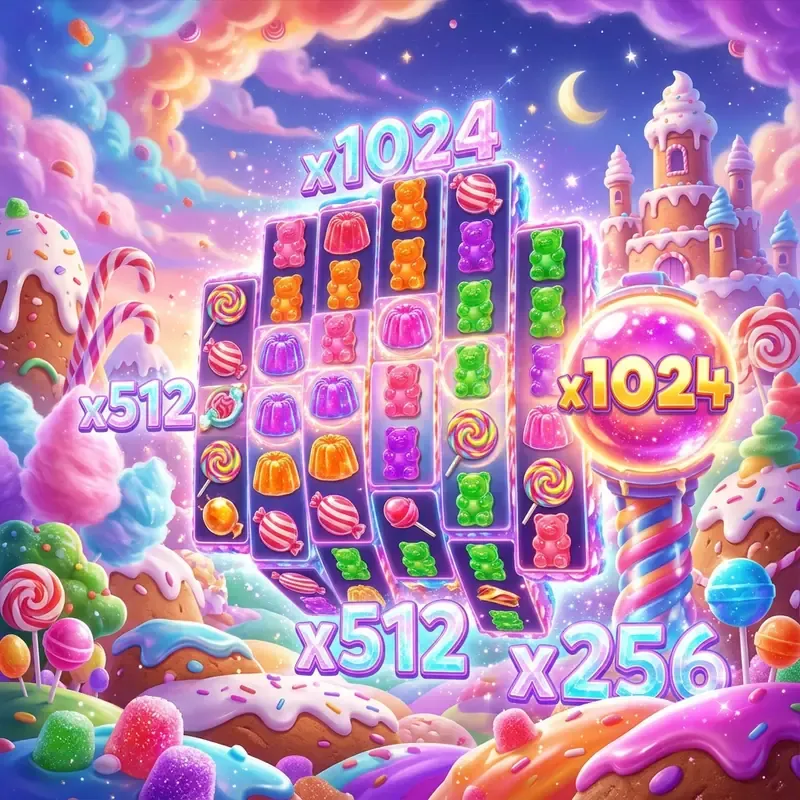
Maximum cell multiplierx1,024
Wild symbolsNone
Bonus Buy100× (Free Spins) and 500× (Super Free Spins), where permitted
MobileHTML5, browser-based on iOS and Android
Three numbers there deserve emphasis. A

Three numbers there deserve emphasis. A hit frequency of 1 in 2.9 means roughly one spin in three returns something, though most of those returns are fractions of your stake, since a minimum five-symbol cluster pays only 0.2× to 1× the bet. A free spins frequency of 1 in 323 means that at three seconds per spin you should expect around one bonus round every 16 minutes of continuous play on average, with enormous variance around that average. And a max-win probability of 1 in 12,800,000 means the advertised 25,000× ceiling is, in practical terms, a marketing figure rather than an outcome any individual player should plan around.

Plan around the middle of the distribution. The tail will do what tails do.

3. Technical Overview of Sugar Rush 1000

3.1 Developer, theme, grid layout and

3.1 Developer, theme, grid layout and max-win positioning

Sugar Rush 1000 is developed and published by Pragmatic Play, one of the largest content suppliers in the regulated online casino sector. The theme is unchanged from the original: a pastel confectionery world of gummy bears in orange, purple and red, plus a star, a jelly bean, a heart and a round sweet. The art direction is cheerful, slightly naïve, and instantly familiar to anyone returning from the first game.

The panel is a 7-reel, 7-row matrix, 49 positions in total, using cluster pays instead of fixed lines. Five or more identical symbols must connect horizontally and/or vertically to form a winning cluster. Payouts scale with cluster size: a minimum five-symbol cluster pays between 0.2× and 1× the bet depending on symbol value, rising to between 20× and 150× the bet for clusters of 15 symbols or more. There are no wild symbols anywhere in the game, base or bonus.

One industry review frames Sugar Rush 1000 as the heftiest of the "1000" series for winning potential, and on the numbers that assessment holds. At 25,000× it clears the ceilings of its stablemates in the same reissue line.

"Sugar Rush 1000 takes the original game and stacks it with so much sugary goodness it's almost too much of a good thing." Bigwinboard slot review (2024).

3.2 Demo mode, free play and

3.2 Demo mode, free play and the online interface

Sugar Rush 1000 demo is widely available: no registration, no deposit, no personal details. The free version runs on virtual credits and reproduces the same rules, symbol set, feature triggers and, critically, the same underlying maths model as real money play. One caveat, covered in Section 6, matters enormously. The demo will almost always display the maximum RTP configuration, whatever the casino has set for real-money wagering.

The value of free play is genuine, though. Slots are learned by playing, not by reading paytables. A straightforward approach: load Sugar Rush 1000 demo, set 100 autospins, watch which cluster sizes and symbols actually generate meaningful returns, then use bonus buy in demo to see the feature run end to end.

Gambling research and regulatory frameworks generally treat demo modes as a comparatively safer entry point, since players learn the mechanics without immediate financial consequence.

Updated: the claim that heavy demo engagement fosters overconfidence which then translates into persistent real-money gambling is not established by the studies cited in this review. It is a plausible hypothesis, not a demonstrated finding, and it needs direct testing. What the behavioural evidence does support is narrower: engagement during a phase with potential wins predicts persistence during a phase with unavoidable losses.

"Participants exposed to a simulated gambling app on their smartphones continued returning for multiple days of play even during a pre-programmed extinction period in which no wins were possible." Smartphone gambling simulation study (pre-2023).

That study predates the 2023 threshold applied to the rest of the research base here. Its findings on persistence remain the most directly relevant evidence available in the absence of a newer equivalent, and should be read with that limitation in mind.

The interface is conventional: a bet control, a spin button, an autoplay panel with loss and single-win stop limits, a turbo/quick-spin toggle, a paytable in the information menu, and, where the operator and jurisdiction permit, a bonus buy button.

4. Game Mechanics: Cluster Wins, Tumbles, Bets and Bonus Features

4.1 Cluster wins and tumble mechanics

4.1 Cluster wins and tumble mechanics on the 7×7 grid

Every winning cluster triggers the tumble sequence. Symbols in the winning combination explode and leave the grid; remaining symbols drop down; new symbols fall in from above to fill the gaps. If the new configuration pays, the tumble repeats. A single paid spin can chain through many consecutive cascades, and that chaining is what makes the multiplier mechanic in Section 4.3 so consequential.

The perceptual side deserves plain language. Because clusters are spatial rather than linear, you scan the grid for shapes and adjacencies instead of reading fixed lines. Pattern-recognition processes are actively engaged during play, which may feed illusions of control or a sense that outcomes are somehow skill-influenced. That mechanism is supported by the quasi-experimental evidence on skill-based versus traditional gaming machines in Section 9.2.

4.2 Bets, stake selection and the

4.2 Bets, stake selection and the sequence of a gaming round

The minimum bet is C$0.20 and the maximum reaches C$240 on operators that allow the full range. Many sites cap it at C$100, and regulated markets often impose far lower ceilings (Germany's GGL framework, for instance, historically enforced a €1 per-spin limit, with later regulatory updates adjusting slot limits upward under defined conditions).

A single round runs like this:

  1. Set the stake using the bet control. On a high-variance title, stake size is the single most consequential decision you make.
  2. Optionally configure autoplay, including a loss limit and a single-win stop. Autoplay is prohibited or restricted in several jurisdictions.
  3. Spin. The 49 positions populate.
  4. Cluster evaluation. Any group of five or more connected identical symbols pays.
  5. Tumble. Winning symbols explode, positions are marked, replacements fall in, re-evaluation follows.
  6. Multiplier assignment. Any position that has exploded twice receives a multiplier (see 4.3).
  7. Sequence resolution. When no further wins appear, the round ends. In the base game, all marked spots clear at this point.

Updated (bankroll guidance): a commonly cited industry guideline suggests bankrolls of at least 200–300× the base stake for high-volatility slots, and roughly 50–100× for low-volatility titles. That figure comes from educational and community resources rather than peer-reviewed research, so treat it as a practical heuristic, not a validated threshold. Its logic, though, traces straight back to the specification table: with a bonus frequency of 1 in 323 spins, a bankroll of 100 spins gives you a better-than-even chance of never seeing the feature at all. If you move from demo to committing real money, that arithmetic, not the 25,000× headline, should set your deposit size.

4.3 Bonus features: Free Spins, Multiplier Spots and Bonus Buy

4.3.1 Scatter symbols, absence of wilds, and free spins structure

Sugar Rush 1000 contains no wilds. The only special symbol is the scatter, which triggers the free spins round:

Scatters landedFree spins awarded
310
412
515
620
730
The round is retriggerable landing 3

The round is retriggerable: landing 3, 4, 5, 6 or 7 scatters during free spins adds a further 10, 12, 15, 20 or 30 spins respectively.

Because free spins arrive on average once every 323 spins, and because their arrival ignores how long you have waited, the round cannot be chased. Treat free spin bonuses as unpredictable windfalls, not targets. Raising stakes or buying the bonus because of a long dry spell has no mathematical justification whatsoever. Note: that framing is a reasonable inference from the game's stated probability structure rather than a directly cited responsible gambling guideline. For formal guidance, consult your provincial regulator's published player-protection materials.

4.3.2 Multiplier Spots and the accumulation

4.3.2 Multiplier Spots and the accumulation of multipliers

This is the mechanic that earns the "1000" in the name:

  • Whenever a winning symbol explodes, its grid position is marked.
  • When a symbol explodes on that same marked position a second time, a x2 multiplier attaches to the cell.
  • Every later explosion on that cell doubles the value: x2 → x4 → x8 → x16 → x32 → x64 → x128 → x256 → x512 → x1,024 (the ceiling).
  • The multiplier applies to all winning combinations formed on top of that cell.
  • Where more than one multiplier joins the same win, the multipliers are added together, not multiplied.
  • In the base game, all marked spots and their multipliers clear once the tumble sequence ends.
  • In free spins, marked spots and their multipliers persist for the whole round and keep growing with each tumble.

That persistence rule is the entire mathematical engine of the bonus. Across 10 to 30 free spins, a 49-position grid can build a lattice of additive multipliers, and it is the collision of a large late-round cluster with several high-value cells that produces the extreme upper tail.

4.3.3 Sugar Rush 1000 bonus buy

4.3.3 Sugar Rush 1000 bonus buy: cost, RTP and what to check first

Where permitted, Sugar Rush 1000 offers two purchase options, a distinction many reviews flatten into one:

  • Free Spins, 100× the bet. Buys a standard bonus round. Spins awarded match the scatter count generated on the triggering spin (3 to 7 scatters, so 10 to 30 spins). Feature RTP: 96.52%.
  • Super Free Spins, 500× the bet. Exclusive to the 1000 version. On entry, starting x2 multipliers are already applied across the grid, so every position begins one doubling ahead. Each subsequent explosion on a cell doubles it again (x4, x8, x16 and onward to x1,024). Feature RTP: 96.55%.

Before you buy anything, check four things in the game rules: that bonus buy is actually enabled for your account, the exact cost at your current stake, whether the feature RTP shown matches the base configuration, and whether any active bonus funds are excluded from feature purchases.

That last one catches people out. Many welcome offers void feature purchases outright, and a voided win is a very expensive lesson in fine print.

The Super Free Spins price point shows providers experimenting at the top end of the bonus-buy spectrum. The marginal RTP advantage (96.55% against 96.52%) is trivial. The variance difference is not. A 500× purchase at C$1 per spin costs C$500 and can return nothing at all. Bonus buys compress a long sequence of variance into one transaction, and that compression is exactly why several regulators have restricted or banned them.

Fact check and jurisdictional limits: bonus buy and autoplay may be unavailable in your market, and the numbers above can change with a build update. The United Kingdom prohibits feature-purchase mechanics, and casinos under Germany's GGL / GlüStV framework apply their own limits on stake, spin speed and bonus purchasing. Several other jurisdictions have banned bonus buys outright, and some operators disable the option voluntarily. Always verify RTP, bonus buy, free spins and multiplier rules in the live game information screen at your casino and in the provider's current rules, not in a review.

5. RTP Settings in Sugar Rush 1000: How Not to Lose 40% of Your Playing Time

Quick take: Pragmatic Play ships Sugar Rush 1000 with multiple selectable RTP configurations, and the operator, not the provider, chooses which one you play. The gap between the best and worst version changes your expected session length by more than 40%.

Published configurations are 96.53% (default and recommended), 95.50% and 94.50%, with some markets also listing a 97.50% high variant. Two casinos can offer what looks like an identical game while returning materially different amounts of money.

The house edge arithmetic

House edge is simply 100% minus RTP:

  • At RTP 96.53%, the house edge is 3.47%.
  • At RTP 94.50%, the house edge is 5.50%.

The percentage gap looks small. The ratio does not: 5.50% is roughly 1.59× larger than 3.47%.

What this means for a C$100 deposit at C$1 per spin

ConfigurationExpected spins (C$100 ÷ house edge)Approx. session length (3 sec/spin)Expected bonus rounds (1 in 323)
RTP 96.53%100 / 0.0347 ≈ 2,882 spins≈ 2.5 hours≈ 8.9
RTP 94.50%100 / 0.055 ≈ 1,818 spins≈ 1.5 hours≈ 5.6
Playing the weakened build costs you

Playing the weakened build costs you more than 40% of your expected playing time, and because bonus rounds arrive as a function of spins played, roughly 40% of your expected free spins triggers as well. You are not only losing money faster. You are buying substantially fewer chances at the feature that carries the game's whole upside.

An analogy that lands with most players: RTP settings are to slots what rule variations are to blackjack. If one table pushes on a tied 18 and another awards the tie to the dealer, the second table is strictly worse, and any sensible player takes the first. At blackjack the rule is printed on the felt. In a slot, the equivalent variation hides in a help screen behind the animation. Which is precisely why you check it by hand.

  1. How to Check the Real RTP in Your Casino (4 Steps)

1
Log in and open Sugar Rush 1000 in real money mode. Non-negotiable. In demo, or while logged out, the game displays the highest configuration (96.53% or 97.50%) regardless of the operator's actual setting. The configured value is only visible in real money mode.
2
Open the information menu, the "i" icon or the settings/gear icon, usually in a lower corner of the screen.
3
Page through the help screens to the game rules section. It usually sits several pages in, after the paytable.
4
Find the line reading "The theoretical RTP of this game is…" If it shows 96.53% or higher, the operator runs the good configuration. If it shows 95.50% or 94.50%, close the game and play elsewhere.

7. Sugar Rush vs Sugar Rush 1000: Side-by-Side Comparison

Quick take: the sequel keeps the theme, grid and cluster mechanic essentially intact. What changes is the ceiling, five times the win cap and eight times the maximum cell multiplier.

Feature / parameterSugar Rush (original)Sugar Rush 1000
Maximum win5,000×25,000× (5× higher)
Max cell multiplierx128x1,024 (8× higher)
Super Bonus BuyNot availableAvailable (500×), starts with x2 on all grid positions
Standard Bonus BuyAvailable (100×)Available (100×)
Grid & mechanic7×7, Cluster Pays7×7, Cluster Pays
WildsNoneNone
Default RTP96.50%96.53%
VolatilityHighHigh
Free spins awarded10–30 (3–7 scatters)10–30 (3–7 scatters)

At review time, Sugar Rush 1000 initially loaded a splash screen inherited from the original advertising "Win up to 5,000× bet". That was an error; the paytable confirms the 25,000× cap. The correction matters, because it is the difference between a modest upgrade and the highest-ceiling entry in the whole "1000" reissue line.

8. RTP, Volatility, Max Win and Empirical Return Data

8.1 RTP configurations and operator variation

8.1 RTP configurations and operator variation

Most slot review sources report a default RTP for Sugar Rush 1000 of 96.53%, slightly above the widely cited online slot average of roughly 96%. Pragmatic Play's own game page has at points listed a basic RTP of 96.00%, which conflicts with the 96.53% carried in commercial builds and independent paytable checks. Where documentation disagrees, only one figure governs your session: the value shown in the game's help screen in real money mode at your operator.

One review calculates that the two-percentage-point gap between a 97.50% and a 95.50% build works out to roughly an extra C$2 lost per C$100 wagered. True enough, but that framing understates the compounding effect across a full bankroll, as Section 5 shows.

8.2 Volatility, hit frequency and probability

8.2 Volatility, hit frequency and probability distribution

Sugar Rush 1000 carries a high volatility (5/5) rating. Simulation data reported in several reviews indicate a hit frequency around 34.4–34.5%, consistent with the stated 1-in-2.9 figure. The combination is characteristic of the genre: frequent small returns that slow bankroll depletion without meaningfully advancing you, punctuated by rare high-magnitude outcomes concentrated in the free spins round.

Educational resources on slot mathematics note, correctly, that RTP is a long-run average, and that short-term results can stray dramatically from the theoretical value, especially in high-volatility games where outcomes disperse widely around the mean. The practical implication is blunt. No realistic private session is long enough for your observed return to converge on the stated RTP.

8.3 Max win, jackpot probabilities and

8.3 Max win, jackpot probabilities and conflicting documentation

The advertised 25,000× maximum win defines Sugar Rush 1000's positioning and is the main reason it sits above other titles in the series. It is not a progressive jackpot. It is a hard cap on a single round's payout, reached through large clusters meeting accumulated cell multipliers during free spins.

The matching probability, 1 in 12,800,000, belongs in every discussion of that number. At three seconds per spin and continuous play, one player would need something on the order of a thousand years of uninterrupted spinning to expect a single occurrence. Players chasing genuinely life-changing single payouts are structurally better served by progressive jackpot titles such as Mega Fortune or Mega Moolah, which pool prizes across networks. Sugar Rush 1000's ceiling is a variance feature, not a jackpot.

8.4 Case data observed RTP in

8.4 Case data: observed RTP in a 1,000-spin real money test

Short-run testing illustrates dispersion. It neither validates nor refutes the stated RTP. A 1,000-spin real money sample is far too small to estimate a 96.53% return with any useful confidence interval on a game whose bonus arrives once per 323 spins and whose upper tail sits at 1 in 12.8 million. A tester who happens to trigger three bonus rounds in 1,000 spins plus one large late-round cluster may log an observed return above 200%. A tester who triggers one weak round may log under 40%. Both results are entirely consistent with a 96.53% game. Treat any published short-session return figure, including the flattering ones, as anecdote rather than evidence.

9. Psychological and Behavioural Research Relevant to Sugar Rush 1000

Quick take: the specific design features of Sugar Rush 1000, cascading near misses, player-triggered feature purchases and prominently displayed RTP figures, map directly onto mechanisms that recent research shows distort player perception. This section reviews that evidence and its limits.

9.1 Near-miss effects in online slot gambling

Cluster grids generate near misses constantly. A four-symbol group one position short of a paying cluster, or a sixth scatter landing where a seventh would have awarded 30 spins, is structurally a loss and perceptually a near win.

"Near-miss outcomes produced statistically significant differences from objectively equivalent full-miss outcomes across all dependent variables in an online slot context." Near-miss effect study in online slot gambling (2024).

The finding corroborates the near-miss effect across subjective measures (enjoyment, frustration) and behavioural ones (continued play, bet size) in an online setting. Methodological caveat: the available reporting does not specify sample size or exact effect sizes, which limits generalisation. It establishes direction, not magnitude.

9.2 Illusions of control in skill-based versus traditional slot-style games

"Among 1,260 online participants, skill-based gaming machine players showed greater illusions of control and stronger beliefs in skill influence than electronic gaming machine players, despite identical payout structures." Quasi-experimental study of SGMs vs EGMs (2024).

This is the best-evidenced finding in

This is the best-evidenced finding in the section: a large sample, a clean comparison, outcomes tied to real survey compensation. Its relevance to Sugar Rush 1000 is indirect but real. The game holds no skill element at all, since cluster formation and multiplier placement are determined entirely by the random number generator. Yet its interactive surface, choosing between two bonus buy tiers, configuring autoplay stops, visually tracking marked cells as they climb, presents the appearance of strategic involvement. The SGM findings suggest appearance alone is enough to inflate perceived control.

9.3 RTP information and gambler perceptions

"Gamblers shown a 90% RTP message rated their winning chances significantly higher than those given no information, with odds ratios exceeding 5 across two studies and two countries." Typical return-to-player information increases gamblers' perceived chances of winning (2024).

This is an uncomfortable finding for

This is an uncomfortable finding for anyone writing an RTP-focused review. Disclosing a return figure, even a bad one, since 90% sits below Sugar Rush 1000's worst configuration, measurably increased belief in winning. The large effect sizes replicated across jurisdictions.

The implication is not that disclosure should stop. It is that RTP has to be communicated as a house-edge statement rather than a return statement. "This game has a 96.53% RTP" invites optimism. "This game keeps 3.47% of everything you wager, and at C$1 per spin you should expect to lose your C$100 within roughly 2,882 spins" does not. That is exactly why Section 5 is framed in house edge and session length instead of percentages alone.

9.4 Responsible gambling messages and self-appraisal prompts

"Players preferred self-appraisal messages, and these were more effective at promoting responsible gambling behaviours than purely informative messages." Study on the effectiveness of responsible gambling messages (2024).

Purely informative messages, statements of odds

Purely informative messages, statements of odds and generic warnings, were both less preferred and less effective at changing behaviour. Methodological caveat: the available reporting does not specify sample size or effect magnitudes, so read this as directional pending fuller data.

Applied to Sugar Rush 1000, the translation is a short set of self-directed questions before a session rather than a list of facts to skim: What is the maximum I have decided to lose today? Have I set a loss limit in the autoplay panel? Am I considering a 500× bonus buy because I planned to, or because the last 200 spins were flat?

9.5 Synthesis what the psychology means

9.5 Synthesis: what the psychology means for playing Sugar Rush 1000

The four strands converge. The cascade mechanic manufactures near misses at a high rate, and near misses sustain play. The interactive surface encourages illusions of control despite the total absence of skill. RTP disclosure, necessary and useful for choosing between operators, simultaneously risks inflating win expectancy. And the interventions most likely to counteract all three are self-appraisal prompts, not information delivery.

The operational conclusion: use RTP information to choose your casino, and use pre-committed limits to govern your session. Two separate functions, and they should not blur. Verifying a 96.53% configuration improves your expected playing time by 40%. It does not make the game profitable, and treating it as permission to play longer or larger turns a genuine edge in operator selection into a net loss.

10. Regulatory Environment for Online Slots and Bonuses

10.1 European regulation of gambling bonuses

10.1 European regulation of gambling bonuses and prohibited risk incentives

European regulatory practice has moved steadily toward constraining promotional mechanics that push players into extra risk. A Decree adopted on 20 December 2023 sets conditions for gambling offers, including restrictions on bonus structures that reward loss-chasing, escalating deposits or extended play. The principle underneath it is simple: a bonus must not work as a mechanism for pushing a player past their intended spend.

For Sugar Rush 1000 specifically, that framework touches two features. Bonus buys turn a discretionary click into an immediate high-variance transaction, and they are restricted or prohibited in several markets. Deposit-match bonuses used to fund high-volatility play interact badly with wagering requirements. A 30× requirement cleared on a game with a 1-in-323 bonus frequency is a materially different proposition from the same requirement on a low-variance title.

Bonus evaluation guidance that fits this regulatory direction, and that also travels well in Canada:

  • Keep playthrough at or below 30×. Above that, the offer is usually better declined.
  • Watch for terms requiring you to wager the deposit as well as the bonus, which doubles the effective requirement.
  • Check whether the bonus balance is fully withdrawable. "No wagering" offers often cap the withdrawable portion well below the headline.
  • Check the maximum bet allowed while a bonus is active, commonly C$5 to C$8 per spin. Breach it and the win can be voided.
  • Apply the general rule that the more enticing an offer looks, the more scrutiny it earns.
10.2 Gambling Act requirements licensing, credit

10.2 Gambling Act requirements: licensing, credit restrictions and bonus money

National Gambling Act frameworks set the baseline conditions under which Sugar Rush 1000 can legally be offered. The operator must hold a valid licence from the relevant regulator. Using credit to fund gambling is restricted or prohibited. Bonus funds must be clearly separated from cash balances with transparent conversion terms. And player-protection tools, deposit limits, session limits, time-outs and self-exclusion, must be present and actually functional.

These are the checks you make before you look at RTP. A favourable configuration at an unlicensed operator is worthless, because the guarantee that the stated setting is the one actually running depends entirely on regulatory testing and certification. Confirm the licence on the issuing authority's public register. In Ontario, that means the AGCO register; elsewhere, the provincial lottery corporation's own platform or the register of the international regulator named in the terms.

11. Practical Implications: Demo vs Real Money, Bankroll, Canadian Access and Mobile

11.1 Demo play as a tool

11.1 Demo play as a tool for learning mechanics and gauging volatility

Free play is the most efficient way to internalise three things a written description conveys poorly: how often marked cells actually build into meaningful multipliers, how long the gaps between free spins triggers feel in real time, and how a 500× purchase performs across repeated attempts rather than in one highlight clip. Run 100 to 500 demo autospins and you will have a better sense of the game's shape than any review can give you. Mine included.

The evidence on demo play's downstream effects is thin, and it should be reported as thin. The most relevant available study found that engagement during a phase with potential wins predicted persistence during a phase of unavoidable losses. It predates the 2023 threshold used elsewhere here, yet it remains the closest available evidence, and no peer-reviewed study specifically analysing demo play in Sugar Rush 1000 has been identified.

11.2 Comparing demo and real money experiences

Three differences matter:

  1. RTP display. Demo shows the maximum configuration; real money shows the operator's actual setting. This is the single most important asymmetry.
  2. Affective response. Identical outcomes feel different when the balance is real. Near misses that are neutral in demo turn aversive with money at stake, which is exactly the mechanism the near-miss literature describes.
  3. Bonus buy availability. Demo builds often include bonus buy even where the operator's real money version has it switched off by regulation.
11.3 Bankroll planning and risk management

11.3 Bankroll planning and risk management for high-volatility slots

Working from the specification table rather than from folklore:

  • With a bonus frequency of 1 in 323, a bankroll sized for fewer than roughly 300 spins gives you a substantial chance of never triggering the feature.
  • At C$1 per spin and RTP 96.53%, expected total spins from a C$100 bankroll is about 2,882, which is roughly nine expected bonus rounds. At RTP 94.50% the same C$100 yields about 1,818 spins, or roughly five and a half.
  • A 500× Super Bonus Buy at C$1 per spin consumes C$500. If your total bankroll is C$100, that purchase is not available to you at that stake, and dropping to C$0.20 to afford it (C$100) means putting your entire bankroll into one transaction.
  • Set the autoplay loss limit to your pre-committed maximum before the first spin, not after the first losing streak.

Note: the 200–300× guideline in Section 4.2 is a community heuristic, not a validated threshold. The spin-count and bonus-frequency arithmetic above comes straight from the game's published specification and is the more defensible basis for planning.

11.4 Mobile access, convenience and the

11.4 Mobile access, convenience and the associated risks

Sugar Rush 1000 mobile play is built in HTML5 and runs in mobile browsers on iOS and Android with no dedicated app. The full feature set travels: cluster pays, tumbles, multiplier spots, free spins and, where permitted, bonus buy, with the interface reflowed for portrait play. On a 6-inch screen the 7×7 grid stays readable, though tracking eight or nine marked cells during a busy free spins round is genuinely easier on a tablet.

Convenience carries a documented cost. As noted, participants exposed to a simulated gambling app on their smartphones showed considerable engagement and persistence, returning across multiple days even during a pre-programmed extinction period with no wins available. The same pre-2023 caveat applies here as elsewhere, and it is cited on that basis consistently.

The mechanism is intuitive regardless: a game that sits three taps away removes the friction that naturally bounds a desktop session.

Mitigations that work with the self-appraisal findings rather than against them: set operator-level deposit limits before you begin, since most licensing frameworks prevent an instant increase, use device-level screen-time restrictions on gambling domains, and do not save payment credentials in the browser.

11.5 Playing Sugar Rush 1000 online

11.5 Playing Sugar Rush 1000 online for real money in Canada: casinos, CAD and payments

So where does a Canadian player actually launch this game? Three routes, and they behave differently.

Provincially operated platforms come first: PlayNow in British Columbia and Manitoba, Espacejeux in Quebec, Atlantic Lottery's site in the Maritimes, and OLG in Ontario. Then Ontario's regulated private market, licensed by the AGCO and operating under iGaming Ontario agreements. Then internationally licensed casino sites that accept Canadian players and hold balances in CAD. Game availability varies by route, and Pragmatic Play content is not present on every provincial platform.

Before your first deposit, run four checks. One: licence, verified on the regulator's register. Two: payment methods and whether the cashier handles Interac e-Transfer and CAD without conversion.

Three: withdrawal timelines and limits, in writing, including the KYC documents you will need. Interac withdrawals commonly clear in 1 to 3 business days at a well-run site; e-wallets can be faster. Four: bonus terms, read line by line, with particular attention to whether slot play from Pragmatic Play counts fully toward wagering and whether feature purchases are permitted at all.

A practical sequence that keeps risk low: play Sugar Rush 1000 demo first, confirm the real money RTP in the help screen after logging in, set a deposit limit, then start at a stake your bankroll can carry for at least 300 spins. If you would rather not deposit yet, the free version stays available indefinitely and teaches the mechanic just as well.

Responsible gambling: real money play on a high-volatility slot involves genuine financial risk, and no configuration, stake pattern or bonus changes the long-run cost. Use demo mode to learn the game, set deposit and loss limits before you play, and never gamble with money earmarked for anything else. You must meet the legal age in your province, 19+ in most of Canada. If gambling has stopped being entertainment, support is available through ConnexOntario (1-866-531-2600) and provincial problem-gambling helplines across the country.

  1. FAQ: Sugar Rush 1000

Respuestas renderizadas en formato acorde al diseГ±o exportado: tarjetas oscuras, acento dorado y despliegue compacto.

1

What is the RTP of Sugar Rush 1000?

The default and recommended configuration is 96.53%. Pragmatic Play also supplies 95.50% and 94.50% builds, and some markets list 97.50%. The operator chooses. Verify it in the game's help screen while logged in and in real money mode.
2

What is the maximum win in Sugar Rush 1000?

25,000× your stake, five times the original Sugar Rush's 5,000× cap. Probability of reaching it is roughly 1 in 12,800,000 spins.
3

How high can the multipliers go?

A single grid cell can reach x1,024, doubling from x2 with each additional symbol explosion on that position. Multiple multipliers involved in the same win are added together. In the original Sugar Rush the ceiling was x128.
4

How often does the bonus trigger?

About once every 323 spins on average. At three seconds per spin, that is roughly one bonus round per 16 minutes of continuous play, with very wide variance.
5

How much does the Sugar Rush 1000 bonus buy cost?

100× the bet for standard Free Spins (feature RTP 96.52%) and 500× the bet for Super Free Spins (feature RTP 96.55%), which starts with x2 multipliers already applied across the whole grid. Availability depends on your operator and jurisdiction.
6

Does Sugar Rush 1000 have wilds?

No. There are no wild symbols at any stage. The only special symbol is the scatter.
7

Do multipliers carry over between spins?

In the base game, all marked spots and multipliers clear when the tumble sequence ends. In free spins, they persist for the whole round and keep growing.
8

Is the Sugar Rush 1000 demo identical to real money play?

Rules, symbols and feature triggers are identical, and the maths model is the same. But the free demo displays the maximum RTP configuration whatever the operator has set for real money play.
9

Can I play Sugar Rush 1000 on mobile?

Yes. It is HTML5-based and runs in mobile browsers on iOS and Android with no app required, full feature set included.
10

Can I play Sugar Rush 1000 for real money in Canada?

Yes, at licensed sites that carry Pragmatic Play content, including AGCO-regulated operators in Ontario and international casinos accepting CAD. Availability varies by province, and provincial platforms do not all stock the title.
11

Is Sugar Rush 1000 available in my country?

Availability, maximum stake, autoplay and bonus buy all depend on your jurisdiction. Bonus buy is prohibited in the United Kingdom, and casinos licensed under Germany's GGL framework apply their own stake and feature limits.
13. Conclusion Evidence-Based Guidance for Playing

  1. Conclusion: Evidence-Based Guidance for Playing Sugar Rush 1000

Sugar Rush 1000 is a well-executed high-variance reissue. It keeps everything that made the original work, the 7×7 cluster grid, the tumble chain, the marked-cell multiplier lattice, the cheerful confectionery presentation, and it raises the ceilings hard: 5× the win cap, 8× the maximum cell multiplier, and a 500× Super Bonus Buy no other entry in the series offers. For players who liked the original and want a steeper distribution, it delivers precisely that.

Four conclusions should shape how you approach it.

First, operator selection is the only decision with a quantifiable edge. Verifying a 96.53% configuration instead of a 94.50% one extends your expected session by more than 40%, and your expected bonus triggers with it. Ninety seconds in the help menu, worth more than any strategy article.

Second, read the probabilities, not the headline. A 25,000× cap at 1 in 12.8 million is a variance descriptor. The numbers that will actually shape your session are 1 in 2.9 (hit frequency) and 1 in 323 (bonus frequency).

Third, handle RTP disclosure with care. The research is unambiguous: seeing a return figure inflates perceived winning chances, with odds ratios above 5. Reframe it. A 96.53% RTP means the game keeps 3.47% of every wager, permanently, without exception.

Fourth, pre-commit and self-appraise. The most effective responsible gambling interventions are self-appraisal prompts, not information dumps. Set your loss limit in the autoplay panel before the first spin. Decide in advance whether a bonus buy is part of your plan. And if you catch yourself weighing a 500× purchase because the last 200 spins were flat, that is the near-miss mechanism working on you, not a strategy.

Sugar Rush 1000 is entertainment with a mathematically guaranteed long-run cost. On the right configuration, inside pre-set limits, at a licensed operator, it is one of the more engaging high-variance slots available today. On a 94.50% build, chasing a bonus, with no loss limit set, it is simply an expensive way to lose 40% faster.

Compare on the facts, read the terms before you deposit, and play responsibly. 19+.

Appendix A Corrected and Superseded Statements

Appendix A: Corrected and Superseded Statements

For transparency, the following formulations appeared in earlier versions of this analysis and have since been corrected or qualified:

  • "Basic RTP: 96.00%." Sourced from a provider game page. Superseded: commercial builds and independent paytable verification report 96.53% as the default, with 97.50% / 95.50% / 94.50% as alternatives. Use the figure in your operator's real money help screen.
  • "Win up to 5,000× bet." Appeared on an inherited splash screen at launch. Superseded: the paytable confirms a 25,000× cap.
  • "Wilds substitute for other symbols in Sugar Rush 1000." Superseded: the game contains no wild symbols at any point.
  • "Extensive demo engagement fosters overconfidence that translates into persistent real-money gambling." Qualified: a plausible hypothesis, not a finding supported by the studies cited. The references originally attached to it (European bonus Decree, Gambling Act, RG-messages study) do not address demo play.
  • "Bankrolls should be at least 200–300× the base stake." Qualified: an industry educational heuristic, not a peer-reviewed threshold. Section 11.3 substitutes arithmetic derived from the game's published hit and bonus frequencies.
  • "Responsible gambling guidelines suggest treating free spins as windfalls." Qualified: a reasonable inference from the stated 1-in-323 trigger probability rather than a directly cited regulatory guideline.